
January 2026 News

With the second batch of Oxygène trainsets for Marseille – Bordeaux Intercités services not scheduled to enter service until 2028/29 it looks as if BB 7200/22200/26000 and Corail stock will need to carry on for another two or three years. On 18 November 2025 BB 22229 passes PN 208 between Villefranche-de-Lauragais and Villenouvelle with the late running Intercités 4758 Marseille Saint-Charles – Bordeaux Saint-Jean.
Once the Bordeaux – Toulouse LGV opens in the early 2030s, Bordeaux – Marseille trains may no longer stop at Agen and Marmande, the transport ministry has said. The Intercités service will be ‘reviewed’ to take advantage of the Oxygène trains’ better acceleration and top speed of 200km/h, more suited to the LGV than the classic route. Agen’s LGV station is to be at Brax 7km to the west; Marmande will not be served. Photo: Georges Turpin.
Oxygène testing
Z 26700 set No 3 on track circuit trials near Plouaret-Trégor on 11 July 2025. Photo: Allain Lloyd/CC Attribution 4.0 International.
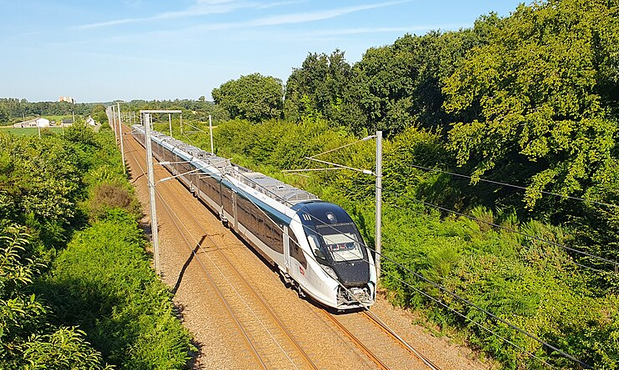
Santa came to Clermont. Honouring a promise made during his National Assembly hearing on 22 October, SNCF PDG Jean Castex visited Clermont-Ferrand on 17 December to discuss the beleaguered Paris Intercités service with elected officials, user groups and other stakeholders. Having said there was no ‘magic bullet’ that would complete the upgrade or deliver the delayed Oxygène trains earlier than next year, he hoped it would be possible “to do a little better”.
One gesture was the transport ministry’s announcement that Clermont and POLT fares would be frozen during 2026 in compensation for the ‘greatly degraded level of service’. This fulfils a long-standing local demand and relieves 4.7 million passengers of the 1.4% inflation increase applied this month. Castex also said that a further €700 million investment would be available on top of the €170 million recently allocated to strengthen the line’s power supply (see December News). This money would be for unspecified work in the period 2028-32. Suggestions put forward locally include ordering extra trains, more bidirectional running and fettling additional sections for 200km/h.
Another project is the ongoing installation of fencing over some 200km of the route to reduce the incidence of animals on the track. The service is plagued by such incidents, as the PDG saw for himself when returning to Paris on the 19.30 Intercités. A train in front had hit a wild boar near Cosne, delaying the IC by 20min.
Union members related problems with defective equipment, poor working conditions and difficulty recruiting. Reliability may suffer further following implementation of new driver rosters. In preparation for opening to competition, Clermont drivers are now confined to either Intercités or AURA TER work; they will no longer be interchangeable. Up to 30 Clermont drivers are passed for the IC route, which is shared with Paris crew. Drivers at Nevers have been TER-only for some years, which has been a further cause of delay when disruption occurs.
July start for TGV M
The first public service with TGV Inoui (ex-TGV M) will be on 1 July SNCF Voyageurs announced on 10 December, the day after it had applied to the European Railways Agency for authorisation to operate the next-generation trains. Only four sets will be passed for service then, so there will be no opportunity to make a big impression in the summer timetable as had been hoped. There should be eight sets ready in September and 13 by the end of the year, with the Christmas holidays now the target for a major marketing exercise, probably on the Paris – Lyon – Marseille route.
TGV M was originally expected to be in service at the end of 2024. SNCF Voyageurs blamed the delays on late deliveries from Alstom and problems during homologation. Alstom has undertaken to deliver two trains per month from September onwards. After proving trials that concluded last August, four sets are in the pre-operating test phase, with two more becoming available in May. Trials continued through to 13 December with set No 1008 based at Besançon for test running between Mâcon and Culoz. It also worked over the single-track line between Mouchard and Saint-Amour.
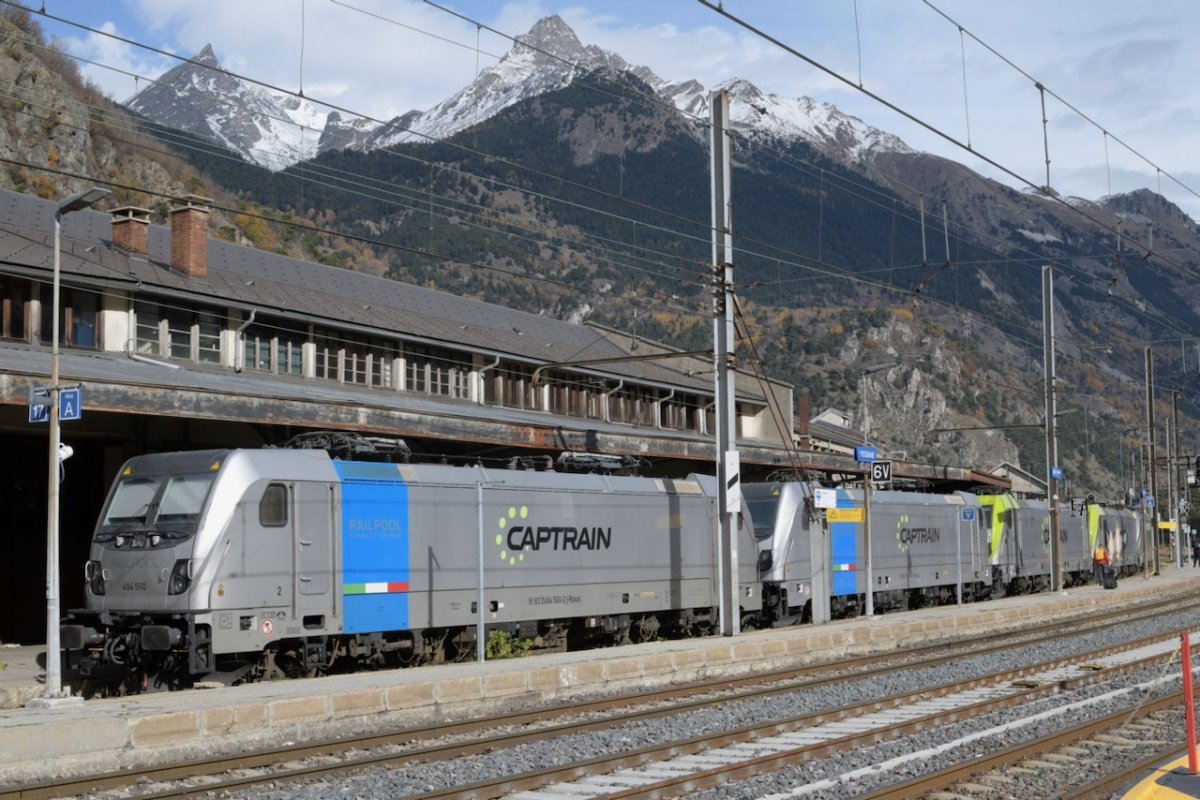
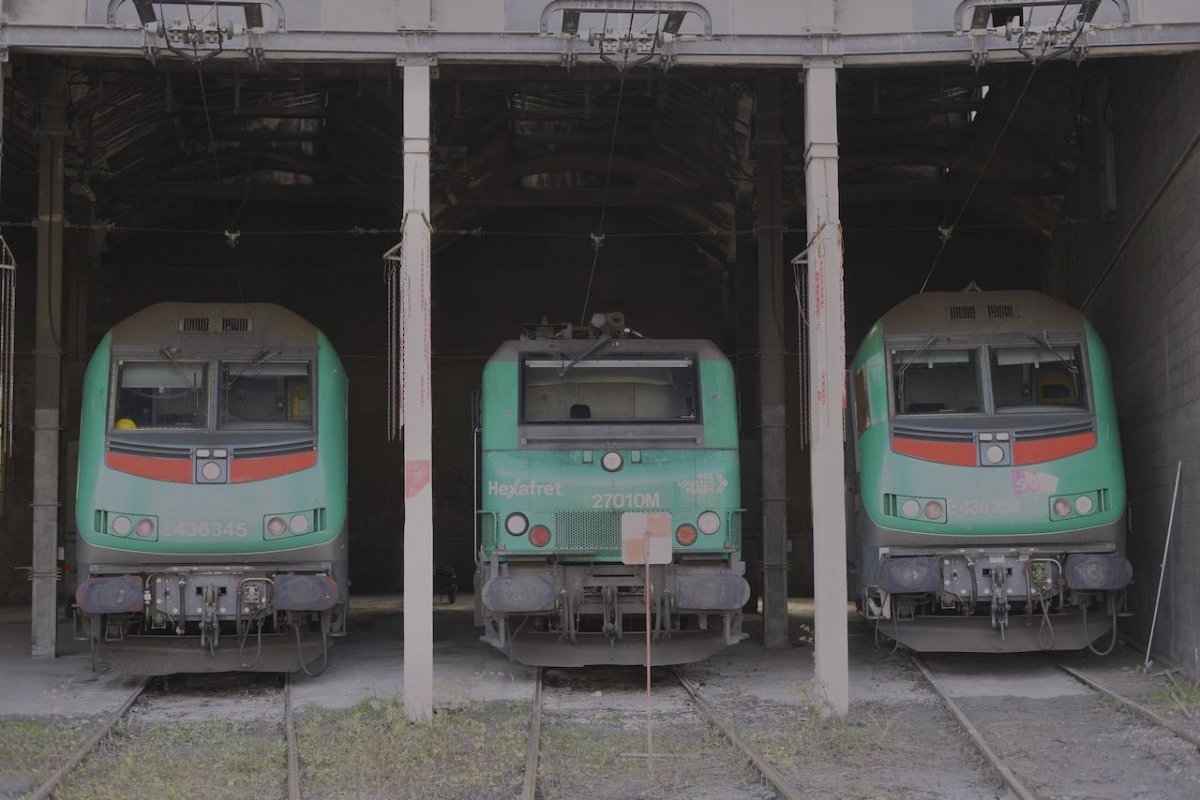
As reported in December News, on 1 November Hexafret withdrew all its Class BB 36300 locomotives, used for cross-border traffic between France and Italy via the Maurienne Valley. They are now being offered for sale with Hungary a likely destination; some of the class are already operating there.
Traffic will in the future be handled by SNCF subsidiary Captrain Italia using Italian-registered Traxx DC3LM (last mile) locomotives leased from Railpool. A line up of five, headed by 494 560, is seen above at Modane on 1 November. On the same day, in the depot waiting to be transferred to Dijon Perrigny, were two BB 36300s and BB 27010. Photos: Jean-Louis Poggi.
Trenitalia heads for London
Trenitalia announced on 29 December a €300 million funding agreement with US investment manager Certares, a travel and tourism specialist. The aim is to ‘accelerate growth and consolidate Trenitalia’s presence in France, the United Kingdom and cross-border markets’. Target date for introduction of Paris – London service is now 2029 and the company is also looking at Paris – Brussels. The French fleet of Frecciarossa trains will almost double to 19.
Having been refused access to London’s Temple Mills international depot last year, Trenitalia is to develop its own maintenance facilities at a site in Île-de-France, intended as the base for its French operations and London services. Total investment in France and the UK will amount to €1 billion. The co-operation agreement also provides for Trenitalia France to promote its services through companies in Certares’ portfolio, active in business and leisure travel, and tourism.
The agreement followed launch on 14 December of five additional services over the Paris – Lyon route with tickets at €14 on the 14 daily A/R. Determined to maintain its advantage in business class patronage as SNCF Voyageurs hits back with its Optimum Plus service (see November News), Trenitalia is working on a business travel loyalty card for introduction later this year. No new services are planned for 2026, designated ‘a year of consolidation’ aimed at raising train-occupancy rates above the current 70%. The €14 offer will last until 14 June, though said to be ‘while stocks last’.
Reviewing its French operations, marketing director Fabrice Toledano said that 4.7 million passengers had been carried in four years, of which 1.8 million in 2025. Passenger satisfaction was over 90% and turnover had more than doubled to €90 million as a result of extending services beyond Lyon to Marseille. Satisfactory results, he said, though the operation made a loss in 2025 and would do so again in 2026, bringing the total deficit to €150 million since 2021. Nevertheless, “progress is in line with our strategy” he said, drawing attention again to France’s very high access charges weighing heavily on new entrants.
Ouigo Espãna in profit
Having taken 20% of the market in its first four years of operation and suffered substantial losses due to its low-fares policy, Ouigo Espãna “will achieve a positive Ebitda in 2025”, its incoming president said. Amandine Thomas-Commin has moved from Intercités to head SNCF’s Spanish subsidiary from 1 January. She will spearhead the next phase of growth based on three new high-speed corridors from Madrid being opened to competition next year: to Galicia (32 paths daily), Asturias/Cantabria (24), and Cádiz/Huelva (16).
Ouigo’s success continues to anger the Spanish government and Renfe, which also faces competition from Trenitalia’s Iryo brand. Very low fares are viewed as ‘dumping’ and the competition as ‘unfair and leading to extermination of the incumbent’. Launch of a daily A/R Barcelona – Seville service on 14 December, with fares of €9 for adults and €7 for children, appears to bear this out. Renfe single tickets for the journey on 14 December started at €96.
Meanwhile, the European Investment Bank has approved a €1.7 billion loan for the final 93km section of the high-speed line linking Madrid to the Basque Y network, completing the prospective standard-gauge route from Madrid into France on the Atlantic corridor. Also, tenders have been called for studies into raising Barcelona – Madrid line speed to 350km/h. Transport minister Oscar Puente said Spain was “going on the offensive to ensure its high-speed infrastructure retains world-leading status”.

Breaking new ground south of Bordeaux: on its first day of operation, 14 December, Ouigo Grande Vitesse 7681 12.11 Paris – Hendaye with Dasye sets 763 and 764 is seen at Morcenx where it made an unscheduled signal stop of several minutes. Despite the lateness here, arrival at Hendaye was on time at 17.04. Photo: John Bamforth.
Sud-Ouest service boost
SNCF Voyageurs is to offer an additional 1.5 million seats annually on services to and from the southwest, including an uplift of about 10% between Paris and Bordeaux. Announcing a range of improvements at Poitiers on 27 November, SNCF said LGV Sud-Ouest was saturated at peak times and capacity of several of the busiest trains would be doubled by running pairs of TGVs. Starting ‘in the spring’, TGVs 8404 and 8414 at 07.45 and 17.09 from Bordeaux will be formed of two sets, as will TGV 8423 at 08.01 from Paris Montparnasse. These extra seats are available thanks to maintenance improvements and diagram changes that allow the Sud-Ouest TGV fleet to be worked harder.
A new train at 06.08 from Tours Centre to Bordeaux, described as ‘an unprecedented inter-regional TGV’, will serve Poitiers and Angoulême en route. From these cities it will be possible to spend 2h 45 longer in Bordeaux, arriving at 08.03, an hour earlier than at present, and with an evening departure 105min later at 20.19. A new Paris – Bordeaux Inoui at 12.54 will fill a gap in the midday service currently occupied by two Ouigos. Retiming of TGV 8571 at 06.38 from Montparnasse will give a 30min earlier arrival at Dax, Pau, Lourdes and Tarbes. To La Rochelle, the last train from Paris will be 30min later at 19.48.
The next stage of Ouigo expansion started on 14 December with launch of a service to Basque coast resorts comprising two TGV Dasye sets offering 1,268 seats. The Ouigo Grande Vitesse runs A/R Paris – Hendaye with a fast 2h 03 timing to Bordeaux, adding 25% more seats daily to the route with fares from €19. After Bordeaux the train serves Dax, Bayonne, Biarritz and Saint-Jean-de-Luz. Additional trains this year from Paris to Rennes (a third daily train), Lyon and Montpellier are as previously announced (June 2025 News). Restoration of low-cost service to Nancy (withdrawn in 2021) is being considered by running a Strasbourg train that way in 2027. Another service under consideration is Paris – Lille, pencilled-in for beyond 2027. The first three refurbished Duplex Tango trainsets were expected to enter service before the end of 2025.
Lyon – Bordeaux. Far from the 'mixed reactions' mentioned last month, the announcement of a Lyon – Bordeaux Ouigo starting next year and running via Massy provoked anger across the Massif Central, particularly in Creuse and Allier, the départements with most to gain from better links to east and west. Still stinging from the closure of the Felletin line, Creuse president Valérie Simonet said “Creuse is simply wiped off the map; again we are excluded and we cannot accept it”.
Responding to the criticism, Alain Krakovitch, PDG of TGV-Intercités, said SNCF was “not in a position to respond with a TGV via the Massif Central” as there is no high-speed route. The Ouigo service was specifically aimed at capturing business from road and airlines, he explained, referring questions about the poor state of the Massif Central infrastructure to the régions. There was still no response to requests for a TET train over the existing route. AURA and Nouvelle-Aquitaine seem unable to work together even to co-ordinate existing services, or at least improve connections at Montluçon and Limoges. NA refused to comment when asked by France 3 Limousin.

The final Nightjet service from Vienna and Berlin arrived in Paris on the morning of 12 December hauled by 185-552, the locomotive that worked the inaugural service in December 2021. It is seen passing Vaires with the locomotive displaying the now-outdated slogan 'Fall asleep in Paris and wake up in Vienna'. Photo: Jean-Louis Poggi.
Night stock order delayed
An initial order for 180 coaches and 27 locomotives was to have been followed shortly by a second tranche (see December News) to deliver a fleet of 340 coaches and 47 locomotives by 2030. Deputés had approved the cost, but this was nullified by failure to pass the State budget. A shortlist of preferred bidders has not been made public but it is understood that Alstom, CAF and Stadler are contending for the €1.1 billion contract.
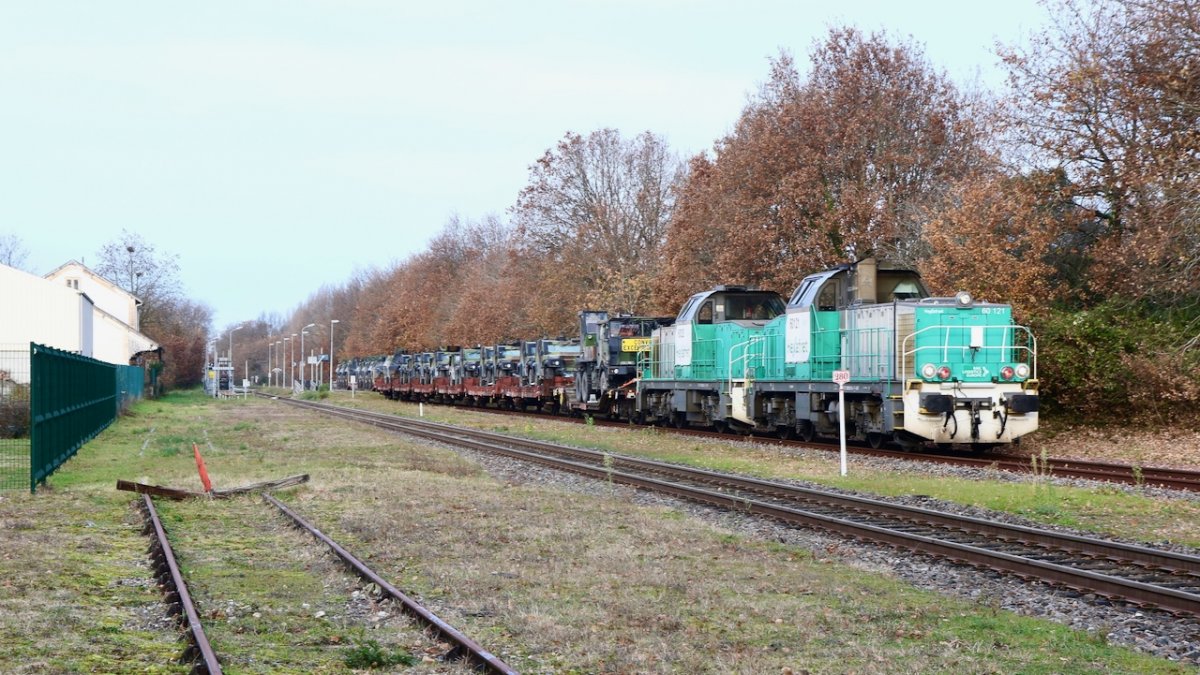
Freight returned to the Castres/Mazamet branch on 15 December with operation of a military train 445415 Saint-Jory – Castres. It had left Châlons-en-Champagne at 17.30 on 12 December and arrived at Saint-Jory at 20.00 the following day having travelled via Culmont-Chalindrey, Lyon, Miramas and the Nîmes – Montpellier bypass. It is seen above hauled by Hexafret BB 60121/60025 waiting for passenger trains to pass at Damiatte-Saint-Paul. The lead locomotive is standing beside Kilometre Post 280 that originated in Bordeaux and applied to the Montauban – Castres – Bédarieux – Montpellier cross-country route, now entirely closed except for the section between Saint-Sulpice and Castres/Mazamet. The track at Damiatte was rebuilt about 15 years ago as part of the Midi-Pyrénées rail plan although the line to the former goods shed has been shortened with two sleepers and a red flag. Photo: Georges Turpin.
Rhône Rive-Droit reopenings
Occitanie confirmed funding in November for reopening three stations on the Rhône Rive-Droit line between Avignon and Pont-Saint-Esprit: at Villeneuve-lès-Avignon and Roquemaure by 2028 and Remoulins (for Pont du Gard) in 2030. Despite the line being used by freight trains and the passenger service restored in 2022, a 14-month study was necessary to revise plans in the light of changed safety regulations. Work is needed on environmental issues, level crossings, protection of flora and fauna, footbridges and other measures. The project, conceived nine years ago and now three years late, is said to have a dossier running to 4,000 pages and is costed at €8 million.
Extension of the Rive-Droit passenger service north to Le Teil in Ardèche département (AURA région), where trains already run ECS to turn back to Avignon, has been delayed for similar reasons. Occasional use of the station is permitted under staff supervision, such as when the Rive-Gauche line is closed, but a footbridge must be built and other safety works costing €2.4 million carried out before regular passenger trains can stop. Construction will start in September and reopening is now scheduled for late 2027. This will restore service to Ardèche after more than 50 years since the département’s last passenger trains were withdrawn in 1973. Would-be travellers might prefer a choice of stations and a service northwards to Valence and Lyon, revival of which is being considered by AURA région.
Rethink on diesel alternatives?
Alstom is ‘pausing’ its work on development of hydrogen fuel cells for traction, citing withdrawal of State and EC subsidies and the problems that have arisen with trains in service. "Hydrogen technology is not yet fully mature. Fuel cell performance is improving, but there is still progress to be made,” CEO Henri Poupart-Lafarge told BFM Business on 24 November. He warned that Europe was falling behind China in development of the technology; observers questioned whether it would ever be a serious contender to replace diesel as a traction fuel.
The activities of subsidiary Alstom Hydrogène will cease and its personnel deployed elsewhere. Alstom said it would honour outstanding maintenance commitments and contracts, including for the 12 Régiolis H2 MUs under construction for AURA, BFC, Grand Est and Occitanie régions (see December News) which should enter service later this year. These are reported to have cost €16 million each. Alstom will be hoping that they perform better that the iLint Coradia trains supplied to RMV in Germany which have been undergoing extensive reworking following a run of technical problems in 2024. As for the four régions, questions are now being asked about the lifetime maintenance and component-replacement costs for the 12 MUs which may turn out to be the only hydrogen-powered trains to run in France.
Lithium-ion ‘going nowhere’, try bioGNV
Working with Ferrocampus at Saintes and natural gas distributor GRDF on the NeoTerra decarbonisation project, NA says bioGNV is now considered ‘mature and reliable’ as an alternative to diesel fuel. A Ferrocampus webinar on 13 November highlighted its benefits, challenges and prospects. The renewable fuel is said to ‘combine [good] environmental performance, cost control, and improved passenger comfort’.
With over 600km of non-electrified route and a fleet of 129 straight DMUs, NA remains highly dependent on diesel fuel; further electrification is seen as too costly. The région had hoped to be a pioneer of battery traction in a joint project with NA, Occitanie, AURA, Région Sud and Hauts-de-France together investing €40 million. B 82775/76 was fitted with lithium-ion batteries by Alstom in 2022 and after successful trials in Occitanie had been expected to move to Bordeaux for running on the Mont-de-Marsan route, but this may not now take place. Despite the technical success of the project, to which NA had contributed €5.7 million, Lagrave said SNCF’s costs for installing charging facilities had increased to “tens of millions of euros above original estimates”. The prototype worked, he said, “but the business model has collapsed”. Photo: SNCF.


BB 22308 R waits to leave Lille Flandres for Calais on 14 September with a set of V2N stock. A recent transfer from Marseille, made redundant by Transdev, these BB 22200s have proved reliable on V2N stock, the problems occurring when the modified R MUX 22200 RC locomotives are used. Photo: Didier Delattre.
Hauts-de-France annual report
“Can do better” said Hauts-de-France transport vice-president Christophe Coulon in his review of the TER network in 2025. The year had started well despite flooding and other climate-related incidents, but operating problems accumulated after the rentrée and he apologised for poor service. Leaf-fall, cold weather and engineering works all contributed to the decline, as well as the behaviour of road users at level crossings and widespread trespass. Service had been particularly disappointing on four lines: Paris – Amiens, Paris – Laon, Dunkerque – Calais and Lille – Douai. Punctuality improved slightly to 89.7%. Peak-hour and Friday evening overcrowding continued to cause difficulties. Coulon urged users to stagger their journeys, adding that the région was doing all it could to provide sufficient capacity. The replacement of the VR2N stock with shortened V2N sets transferred from Paris for services around Lille has not been a success. Availability has been poor with numerous failures in traffic, resulting in delays, cancellations and substitution with other rolling stock.
Maintenance of trains and infrastructure was straining resources; engineering work regularly required bus substitution of late-evening and early-morning services, whilst the trains themselves often froze overnight and failed to start. “We can see what has to be done in terms of maintenance and preparation in the morning”, he said, promising improvements for 2026.
SNCF Réseau will spend €500 million in HdF this year, of which €170 million is for maintenance and the remainder for renewal of track and infrastructure. New track will be laid between Abbeville and Conchil-le-Temple, Mitry-Mory and Crépy-en-Valois, and Avesnelles and Aulnoye-Aymeries (also catenary renewal); plus OHE works at two locations on the Lille – Amiens – Paris line. Work continues on the LGV Nord 10-year programme to renew 64 turnouts, with seven being replaced this year; and on the €92 million Laon – Hirson upgrade. Between Beauvais, Abancourt and Le Tréport , three underbridges will be replaced and remedial work carried out on a further 13 structures.
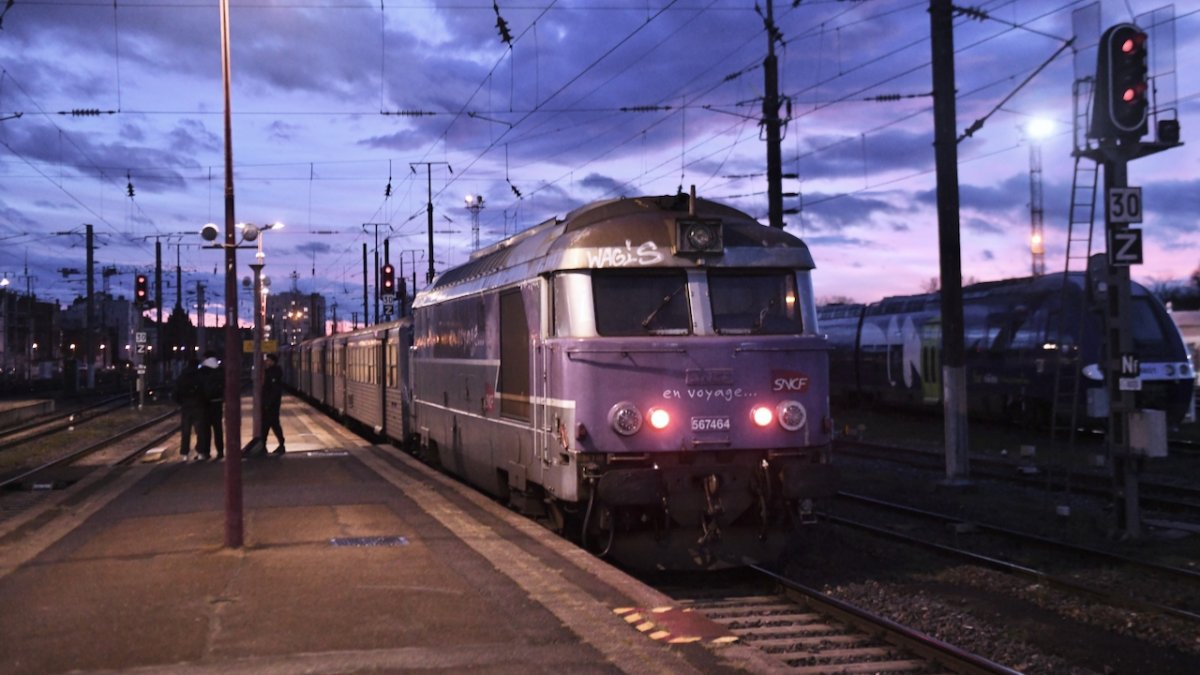
Grand Est TER continues to operate two or three Class 67400 diesels daily on rush hour services from Strasbourg, the last regular workings of this class. Above, on 8 December BB 67464, dating from April 1971, propels two RRR sets away from Strasbourg with the 17.01 to Saint-Dié. It was followed later that evening by another classmate on the 20.01 to Saint-Dié, the two sets returning on the 06.11 Saint-Dié and the 06.11 Saales the following morning. Below, BB 67576, a veteran from January 1974, arrives at Bischheim on 9 December. It had worked the 05.59 from Strasbourg to Lauterbourg and the 07.30 return and will now park up until the afternoon when it will return to Strasbourg and work the 16.20 to Lauterbourg and 17.40 return.
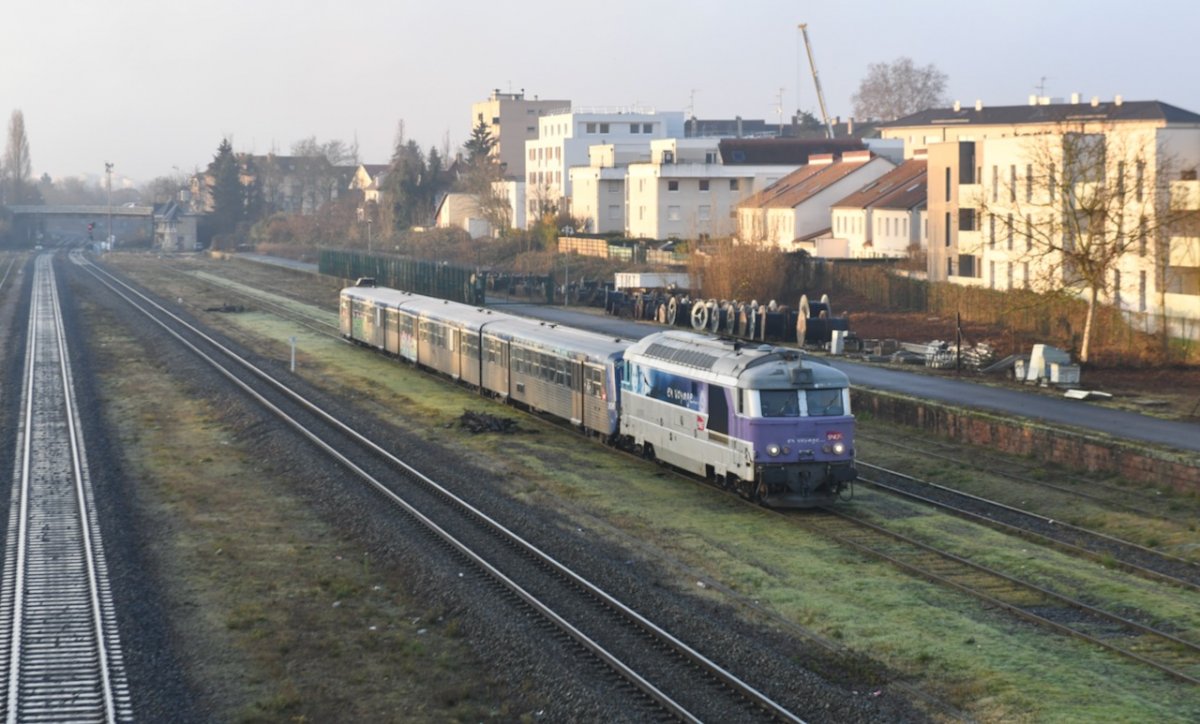
The retention of 50-year-old diesels on these services may seem surprising given the current availability of Class B 85500 Régiolis units that have yet to be introduced on cross-border services to Germany. The issue may be one of capacity, the four-car B 85500 having only 220 seats compared to 293 in a three-car RRR set, the same as a six-car Régiolis unit. At present the B 85500s have largely replaced AGCs in Alsace even covering duties such as the branch to Kruth.
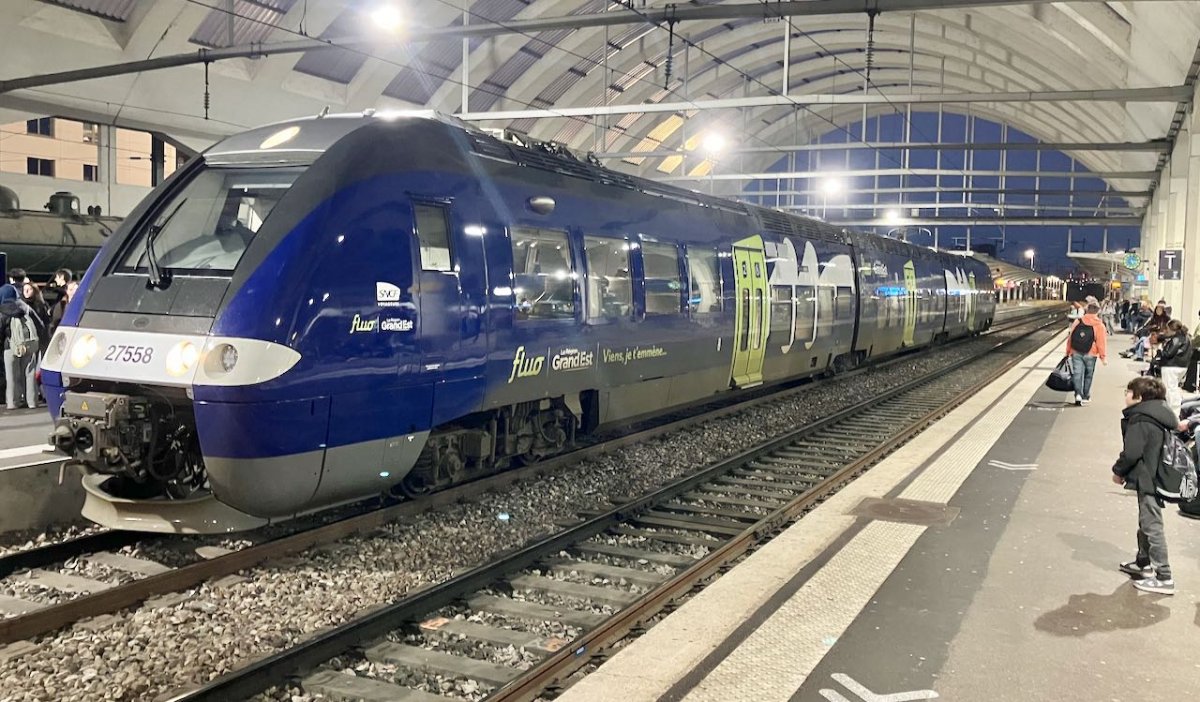
Having started to repaint their AGC fleet in a pale blue and grey livery those undergoing a midlife refurbishment under the OPTER programme receive a darker blue version with pale green doors.
Z 25587/8 waits to leave Reims on 12 December with the 17.19 to Épernay.
News in Brief


Over the weekend of 19-21 December Compagnie des Alpes launched its first night train, the Travelski Night Express, between Paris Gare de Lyon and the Tarentaise Valley. Developed in partnership with the French company Pegasus Trains and marketed by the travel agency Travelski, it serves three stations in Savoie: Aime-La Plagne, Moûtiers-Salins-Brides, and Bourg-Saint-Maurice. The train journey is part of an all-in package starting at €800 including road transfer to the customer's chosen resort, accommodation, equipment hire and ski pass; individual reservations are possible (from €80).
The train consists of 10 couchette carriages belonging to German leasing company GfF Crailsheim providing 660 berths, and a bistro car from Dutch company Happytrain Fleet Services. Staff and crew are Belgian and Dutch. It is operating over 14 weekends between 19 December and 20 March, departing Paris on Friday at 22.52 (Train 5701) with a Saturday morning arrival. It returns from Bourg-Saint-Maurice that evening at 21.33 (Train 5700) arriving in Gare de Lyon just after 06.00 on Sunday morning, giving skiers eight days on the slopes. On the first weekend of operation, the train was said to be only one-third full.
Traction is provided by Europe Express using Akiem’s two BB 75300s that are not hired out to Intercités, BB 75326/75330. These had been used earlier in the year to haul the Golden Eagle Danube Express. The locos are fuelled during the unadvertised stop at Albertville where they run round for the last leg of the journey to Bourg-Saint-Maurice. The train’s advertised environmental credentials are somewhat marred by the use of diesel traction over the entirely electrified 680km route. Electric locomotives were said to be unavailable for hire.
Train 5700 is seen after arrival at Gare de Lyon on Sunday 21 December. The lead locomotive was then cut off and moved to the rear of the train to take the stock to Trappes where it was stabled until the next weekend. Photos: Christophe Masse.


Marseille Est. SNCF Voyageurs has ordered 22 six-car Régiolis EMUs from CAF for the Marseille – Toulon – Hyères/Les Arcs-Draguignon routes that will be operated on contract from December 2029 by SNCF Voyageurs Sud Alpes Méditerrannée (see November News). Région Sud is funding the €250 million cost.
Crespin. If no new orders are received by the summer, Alstom says the Omneo production line at Crespin may be closed when outstanding contracts are completed in late 2027. Under the 2010 framework to supply up to 860 Regio 2N EMUs to SNCF, 558 have been ordered so far.
Claret joins Velvet et al. Regulator AMT has approved SNCF Réseau’s offer of paths between Paris and Lyon for Claret, another new entrant to the high-speed market. Headed by former Eurostar PDG Nicolas Petrovic, the start-up has yet to say what rolling stock it would use.
PaxOne for IC. SNCF has awarded a €40 million eight-year contract to Wiremind to develop real-time management of inventory, pricing and data for Intercités ticketing. Wiremind is the company behind CayZN, the revenue management system that has helped maximisation of Ouigo’s turnover and profit. To be known as PaxOne, the IC system will be deployed first with SNCF Océan when it takes over running of the Nantes – Bordeaux/Lyon routes next year, and then extended to all IC and ICN routes as they are opened up to competition.
Thouars. The three daily trains to Saumur (39km) have had 15min added to the 35min journey time due to the poor state of the track. The once-daily through train from La Roche-sur-Yon to Thouars and Saumur (plus the Train des Plages in summer) continues to hang by a thread, awaiting approval for track upgrading at a cost of €240 million. Saumur – Thouars was electrified under the Angers area scheme in 1982 to ease handling of heavy stone traffic from local quarries, although both passenger and freight trains now operate with diesel traction.

Hexafret. A batch of Eamnos open wagons with a capacity of 57m3 is under construction by Greenbrier at its Drobeta Turnu Severin works in Romania. They are for bulk transport of materials such as scrap, aggregates and steel components. Photo: © Greenbrier Europe.
RER Line D. Recasting of the timetable from 14 December sees all trains stopping at Maisons-Alfort Alfortville, Le Vert de Maisons and Créteil Pompadour where traffic growth now demands increased frequency. Extra stops at Le Vert de Maison prepare the station for opening of GPE Line 15 Sud in April 2027; 90,000 passengers daily are expected to interchange here.
Nord – Est link. Construction of the 60m pedestrian tunnel to link Gare du Nord Magenta and Gare de l’Est in Paris is one-third complete. The short distance and awkward alignment preclude use of a boring machine so hand-held equipment is the order of the day. Opening is scheduled for March 2027 to coincide with the start of CDG Express from Gare de l’Est.
On the Blanc-Argent line, the school-term timetable is to operate throughout the year to provide better service during holiday periods. The afternoon Romorantin school train to Valençay, TER 861259 at 16.16, now starts from Faubourg d’Orléans at 16.10, eliminating a bus connection. The 06.54 Salbris – Valençay terminates at Gièvres at 07.51, replaced by a new Romorantin – Valencay at 09.27.
TGV seating renumbered. Some 400 volunteer staff laboured overnight on 13/14 December to renumber the 123,000 seats on all 364 TGV Inoui sets. The old numbers are replaced by three digits, the first of which denotes the coach number, a 'simplification' which SNCF says will eliminate 'a source of stress for passengers'.
Libourne. The State has granted €1.4 million towards the €34.2 million cost of a multimodal interchange and terminal facilities for Line 41+, the Arcachon – Libourne cross-Bordeaux service at the core of the city’s SERM plans. Work starts after the municipal elections in March and will take a year. Platforms 3 and 4 on the west side of the station will be rearranged as terminating tracks for incoming Line 41+ trains, while loop tracks 9, 11 and 13 on the east side will provide space for five Régio 2N sets, with facilities for light maintenance and one track equipped for both underfloor and roof-level inspection.
Also on Line 41+ and part of the SERM project, Saint-Loubès station reopened on 13 December after platform lengthening and raising, new lighting and shelters, renovation of the subway and new parking for 57 cars; cost €4.4 million. There is hourly service to Bordeaux and Arcachon except at 15.XX, and to Libourne except at 09.XX.
Grand Est is to extend its usual summer and winter holiday service cuts to the half-term fortnight beginning 16 February, citing a reduction of up to 20% in passengers during the period. Reduced service levels will now apply over 15 weeks of the year. Applications opened on 1 December for finance of up to half the cost of upgrading, reopening or building new private sidings or freight connections in a scheme jointly funded by the State and the région. Up to €1 million is available for each upgrade and up to €1.25 million towards new construction. This is an initial stage of the Strategy Fret Grand Est approved last October (see November 2025 News).

The prototype EcoTrain railcar (see July 2025 News) was displayed at the Grande Exposition du Fabriqué en France innovations exhibition at the Élysée Palace in Paris on 15-16 November prior to start of dynamic trials. EcoTrain SAS has been set up to seek turnkey contracts for renovation of closed lines where the railcar could operate under light railway regulations independently of the main network.
At the same time, Occitanie confirmed its plan to test the Draisy railcar on the Carcassonne – Limoux line. Bids are to be sought for a survey of the line’s suitability for the battery-electric car, necessary even though the branch was entirely rebuilt in 2019. Installation of recharging facilities would also be required. At Parthenay on 13 November, l'Association des usagers du train Nord-Poitou held a seminar on the technology and prospects for the Telli project. The association is hoping the light railcar will reinforce its proposal for reopening to passengers of the 88km Thouars – Parthenay – Niort freight-only line.
Digital signalling was commissioned on 24 November over the 20km between Saverne and Réding (Sarrebourg) west of Strasbourg and the 1933 signalbox at Lutzelbourg closed. This is the first deployment of the Argos digital interlocking following the pilot installation at Chasse-sur-Rhône last April. Argos is part of the €35 billion long-term programme to bring the entire network under the control of 20 signalling centres, 12 of which are operational.
Patronage on the Luchon branch reopened last June is ‘exceeding all expectations’, with 60,000 carried in the first six months. SkiRail combined ticketing was launched on 1 December, at €43 from any station between Toulouse and Montréjeau on the early-morning through train to Luchon, including transfers to local resorts and a lift-pass. Hydrogen-powered trains are expected to start test running to Luchon in September. Also on the line from Toulouse, the rebuilt Martres-Tolosane station opened as a multimodal interchange on 14 December.
Modernisation of the Arve valley line between La Roche-sur-Foron and Le Fayet, originally planned for 2026 and then 2028, is now scheduled over 20 months during 2030-31. Elected officials are upset that the line will not be upgraded in time for the Winter Olympics, and worried that the €260 million funding granted in 2020 will expire.
Aurillac – Brive. Users complain of disruption to the timetable (four A/R daily) described as ‘useless’ for commuting. The morning trains to Brive arrive too early or too late, and the only return service is at 19.35 by bus connection from Saint-Denis-près-Martel. The line suffers from its position along the borders between AURA, which manages the service, Occitanie and Nouvelle-Aquitaine; local communes are seeking participation of the other régions in providing improved service. SNCF is so short of staff and serviceable trains at Brive that passengers are advised to check their journeys every day.
Ham sandwich? That’ll be £5,000! Eurostar passengers found little Christmas cheer amongst customs officers stepping-up enforcement of food-safety regulations over the holidays. Intended to guard against the spread of foot-and-mouth disease, carriage of French meat and dairy produce is banned, even sous vide (vacuum-packed) and including sandwiches. The rules apply in both directions and smugglers face fines of up to £5,000.
Mont-de-Marsan TGV. Location of the GPSO station on the originally-planned site at Lucbardez, 13km northeast of the town, was confirmed in November after alternatives were rejected. The site is adjacent to the former Mont-de-Marsan – Marmande line closed to passengers in 1938; this could be utilised to extend the existing Bordeaux TER service from the town to the TGV station.
CF de la Rhune. Patronage was slightly down in 2025 at 290,000, attributed to the poor economic situation. Aiming to reach 300,000 passengers again in 2026, the railway must balance tourism with conservation, the four daily return trains with total capacity of 480 acting as a brake on numbers visiting the summit. Return tickets (€25.50) are compulsory.
Photo: Sud Ouest/PS.
CF de la Rhune. Patronage was slightly down in 2025 at 290,000, attributed to the poor economic situation. Aiming to reach 300,000 passengers again in 2026, the railway must balance tourism with conservation, the four daily return trains with total capacity of 480 acting as a brake on numbers visiting the summit. Return tickets (€25.50) are compulsory.

Several local disputes hit the network at Christmas despite a €400 bonus to dissuade staff from striking over the holidays. In Grand Est, a strike on 24 December and seasonal staff shortages disrupted services, with many early and last trains replaced by buses in Lorrain, Champagne-Ardenne and Alsace. Grand Est région called upon SNCF to ‘ensure the continuity of public service, especially for the end-of-year celebrations’. In Hauts-de-France signalling staff on five routes struck on 24-25 December and then extended the walk-out until 4 January. Trades union Sud-Rail called the bonus ‘a joke’ and gave notice of a strike on 13 January, calling for a general wage increase of €400 per month.
The year ended on 31 December with VSOE liveried BB 26019 rostered to work Intercités 3619 8.26 Paris Austerlitz – Toulouse. Seen above after arrival at Toulouse. The locomotive has been run around and attached to the Paris end of the train, ready to be dragged to Raynal for overnight stabling, before returning to Paris on 1 January with 3650 10.27 Toulouse – Paris Austerlitz. Photo: Georges Turpin.
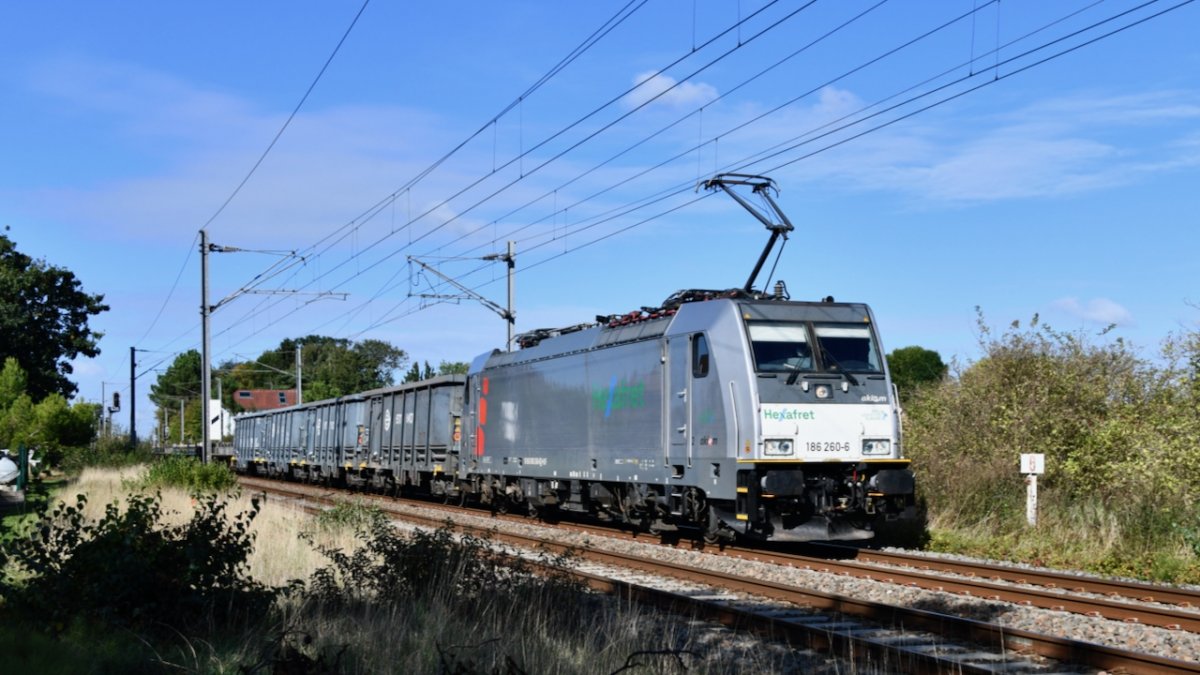
Hexafret Traxx 186 260, leased from Akiem passes Ascq on the 19 September with Train 49839 Berguette – Charleroi. Photo: Didier Delattre.
Thionville – Forbach to reopen
No costings were made available by GE as final figures would depend on further studies into upgrading the infrastructure to passenger standards, and the work necessary at stations. At least four are planned: at Yutz, Metzervisse or Kédange-sur-Canner, Bouzonville and Creutzwald; discussions continue with local communes on other possible stops. The région admitted that rolling stock availability would impact the project’s timescale and dismissed as ‘too soon’ reports mentioning 2031 as the reopening date.
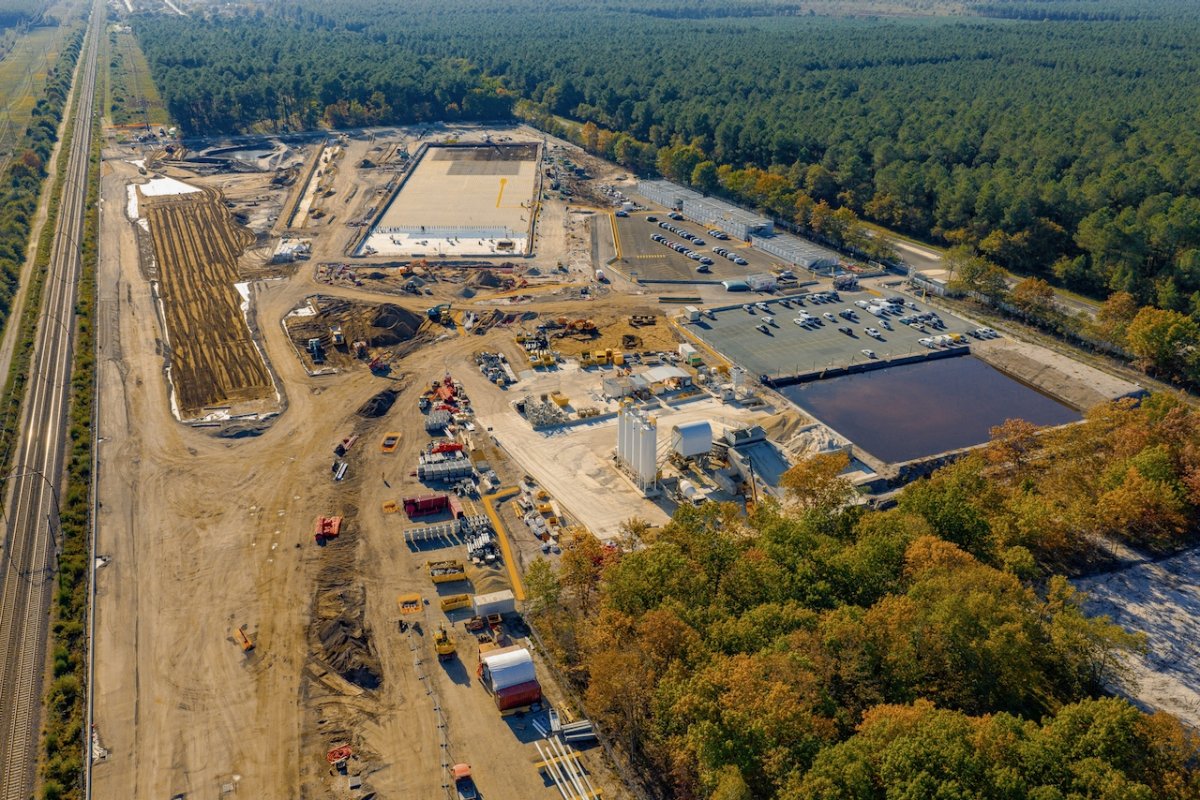
Marcheprime takes shape
Local residents were given a tour on 15 November of the works at Marcheprime, south of Bordeaux, where Tours – Bordeaux LGV concessionaire Lisea is building a train maintenance depot for new passenger operators. The visit coincided with the start of preparatory work by SNCF Réseau for laying a connection to the adjacent Midi main line, 3km north of Marcheprime station, scheduled for later this year.
On opening in 2028, the depot will offer maintenance and overnight servicing of high-speed and conventional trains, initially for Proxima’s 12 Avelia Horizon Velvet trainsets which will be maintained here by Alstom. The site breaks new ground in providing facilities in the southwest, located close to the future Bordeaux – Toulouse/Dax LGV and well-placed for any high-speed services that might run into Spain once the Basque Y is operational. SNCF’s TGV maintenance depots are grouped round the Paris terminals, and also at Lyon. Lisea also envisages the depot as a possible base for new entrants bidding to run Nouvelle-Aquitaine’s TER services and Bordeaux’s SERM.
View above of the site looking south with the Midi main line left; Marcheprime station is 3km distant top left.
Photo: ©Spie Batignolles Génie Civil/GA.
Canfranc doubts
Further consultations were held during December on the planning and environmental implications of the proposed reopening between Bedous and Canfranc as a rolling motorway that would see the entire route from Pau rebuilt and electrified for cross-border freight and passenger trains. Though at first mostly well-received, opposition is hardening, with Pau agglomeration worried about the implications of heavy freight trains passing through.
Opponents describe the project as ‘greenwashing’ and likely to increase rather than reduce the number of lorries using the narrow RN134 road in the vallée d’Aspe as the distance between Pau and Zaragoza is said to be too short for ferroutage to be economic. The Oloron-Sainte-Marie – Bedous reopening is criticised as a ‘phantom railway with a golden subsidy’ for the four daily trains which carry around 90 passengers, and the further planned expenditure of up to €450 million as unjustified when rural lines in Nouvelle-Aquitaine (NA) are struggling for lack of investment.
Long-time supporter NA president Alain Rousset said “the enormity of the lies [from opponents] surprises me. Seventy trains a day? It is totally impossible to pass [so many]”; SNCF’s own forecasts suggest 50 trains a day. Another supporter, the maire of Oloron-Saint-Marie, said: “It is planned on opening to run six [freight] trains a day with about 30 lorries per train. So that's 180 trucks that we'd take off the road.”
In any event, infrastructure on the Spanish side will be ready long before Bedous – Canfranc is rebuilt. Following upgrading of the Huesca – Canfranc line with dual-gauge sleepers for installation of a third rail for standard gauge, infrastructure authority Adif is spending €6.2 million lengthening passing loops to 750m between Huesca and Zaragoza. It is expected to announce a contract for rebuilding Somport tunnel early this year.
The grain in Spain. A form of rolling motorway is already operating since reopening of the railway on the Spanish side last June. Movement of French grain from silos at Canfranc to Zuera, Sariñena and Lérida started in July, operated jointly by Transcanfranc, Go Transport and Alsa Rail. Initially once-weekly, the service was augmented to four times a week in November. Grain from southwest France (Béarn) is taken by road to Canfranc for transshipment to hopper wagons for the journey south. Future shipments are expected to include corn, durum wheat and other grains from France to a variety of locations in Spain. Alsa has also been running a tourist shuttle between Canfranc and Jaca using historic rolling stock.
Photo: Creloc.

X 73773 calls at Buzy-en-Béarn on 4 October 2024 with the midday train from Bedous to Pau, TER 667426. The passing loop is behind the righthand platform. Rusted lattice masts of CF du Midi origin are a reminder that the line’s original electrification was dismantled in 2008.

Better for Bedous? Under fire for poor performance of the Pau – Oloron – Bedous line, SNCF Voyageurs is implementing measures to improve reliability, though much of the disruption has been beyond its control. Staff sickness, strikes and bad weather led to 10% of trains cancelled in late summer, then 40% in November due to strikes every Friday and a breakdown in fuelling facilities at Pau. Replacement buses are sometimes full at Pau; users resort to informal carpools, particularly at stations between Oloron and Bedous.
The line suffers as the only diesel operation in an otherwise electrified area. The X 73500 railcars are far from their home depot at Limoges and the DMUs based at Bayonne for the Saint-Jean-Pied-de-Port line are 105km distant. Apart from fixing the fuelling problem, SNCF will step up maintenance procedures for the 25-year-old trains and try harder to ensure that rostered staff are available. User groups are pressing for commissioning of the passing loop at Buzy-en-Béarn to aid recovery from out-of-course running. It was laid in 2012 but has never been used.

Toulouse infrastructure developments
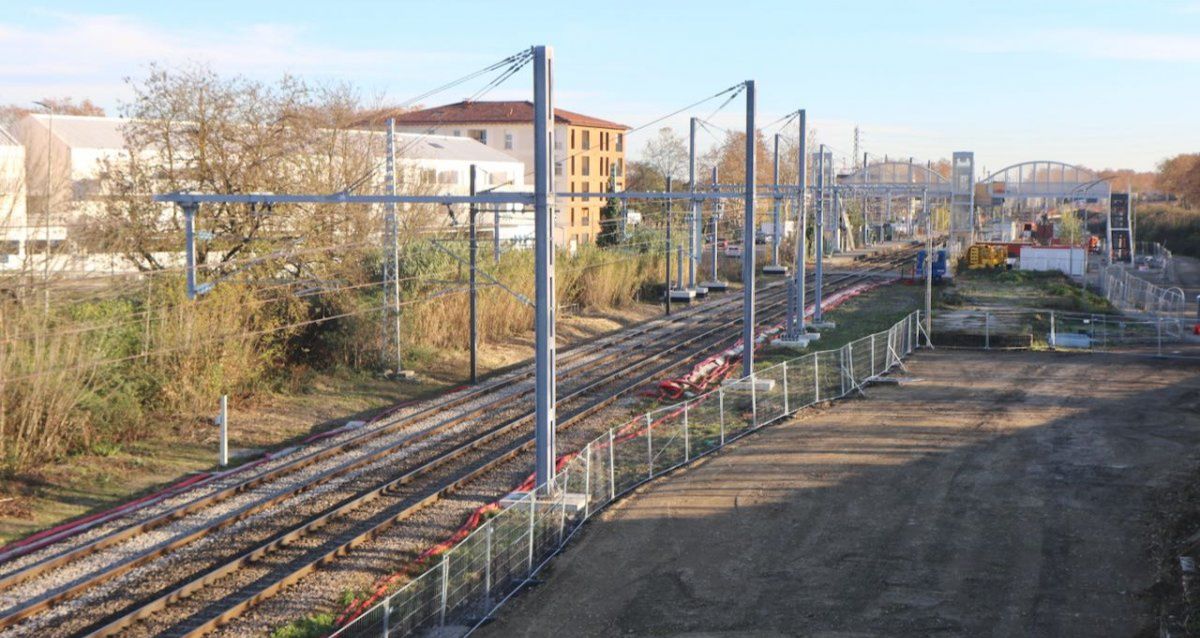
At Toulouse Matabiau, work is underway on the site of the depot with the creation of the future Metro Line C. The photo above shows the view of the former entrance to the depot from the south end of the station. In the middle is the fuelling shed and on the right the Tour d'Argent, the old SNCF regional headquarters building, which is being demolished. The excavations are for the Line C Matabiau station which will have direct access to the SNCF station.
Further north at Saint-Jory the ground is being cleared to lay additional tracks for the Bordeaux – Toulouse GPSO (Ligne Nouvelle du Sud-Ouest) and the AFNT (Northern Toulouse Rail Improvements) project.
The footbridge spanning the two existing tracks has been extended to provide access to a future platform near the Canal Latéral de la Garonne. On the existing tracks, numerous poles and catenary supports have been replaced. In the photo, an old lattice pole, likely dating from the line's electrification in 1935, can be seen on the left.
Both photos: Georges Turpin.
Y change for Line C
A tender will be launched in January 2026 for the procurement of 55 new double-decker trains. The call will seek existing, proven models from manufacturers, avoiding bespoke development. These trains will be designed for compatibility with the current infrastructure, with the potential for additional orders to support full RER C fleet renewal. ÎdFM confirmed on 18 November that the branches of Line C from Brétigny-sur-Orge to Saint-Martin d’Étampes and Dourdan-la-Forêt will be split off in 2032 to become Line Y. Its trains will run northwards only as far as the terminal platforms at Gare d’Austerlitz rather than continuing across Paris, with limited stops to cut journey times. The move is intended to improve reliability over one of the poorest performing sections of the RER, where punctuality is only 85%.
Objections by some of the communes concerned have been overcome, principally by the offer of faster journey times to Paris and evening peak-hour passengers having empty trains available to board at Austerlitz instead of cramming into services from the north that are already full. Only 20% of passengers from the two branches travel north of Austerlitz. From Dourdan, journey time to Austerlitz will be 40min instead 1h 06 at present with 14 stops.
The 176km Line C is undergoing a €4 billion modernisation in a 10-year master plan adopted in 2024 (see July 2024 News). A fleet of 105 NG trains will be introduced from 2033, maintained at depots to be built at Brétigny-sur-Orge (with the 55 Line Y trains) and Gennevilliers, plus the existing depot at Les Ardoines which will be modernised. Another factor influencing the Line Y project is the limited headroom in the Invalides – Austerlitz tunnel through central Paris. Though used by Z2N double-deck stock, the tunnel cannot accommodate NG trains until track lowering by 30cm is completed, hence the delay in ordering new rolling stock for Line C.
Line C has six branches serving 84 stations and carries 550,000 passengers daily. Simplification of the route structure began in 2006 with transfer of the Ermont-Eaubonne – Argenteuil section to Transilien Line J. In 2023 Épinay-sur-Orge to Massy-Palaiseau was rebuilt as the T12 tramway, then a year later the short section thence to Versailles-Chantiers was hived-off as shuttle Line V. Amputation of the two southern branches will make for a more balanced cross-city service and relieve the congested tunnel between Austerlitz and Invalides. Track remodelling and additional loops and crossovers are planned at several locations, including Avenue-Henri-Martin, to facilitate turnback of trains when operations are disrupted, and Brétigny-sur-Orge station is being rebuilt to handle additional services on the four-track section towards Paris. Map: Le Parisien.

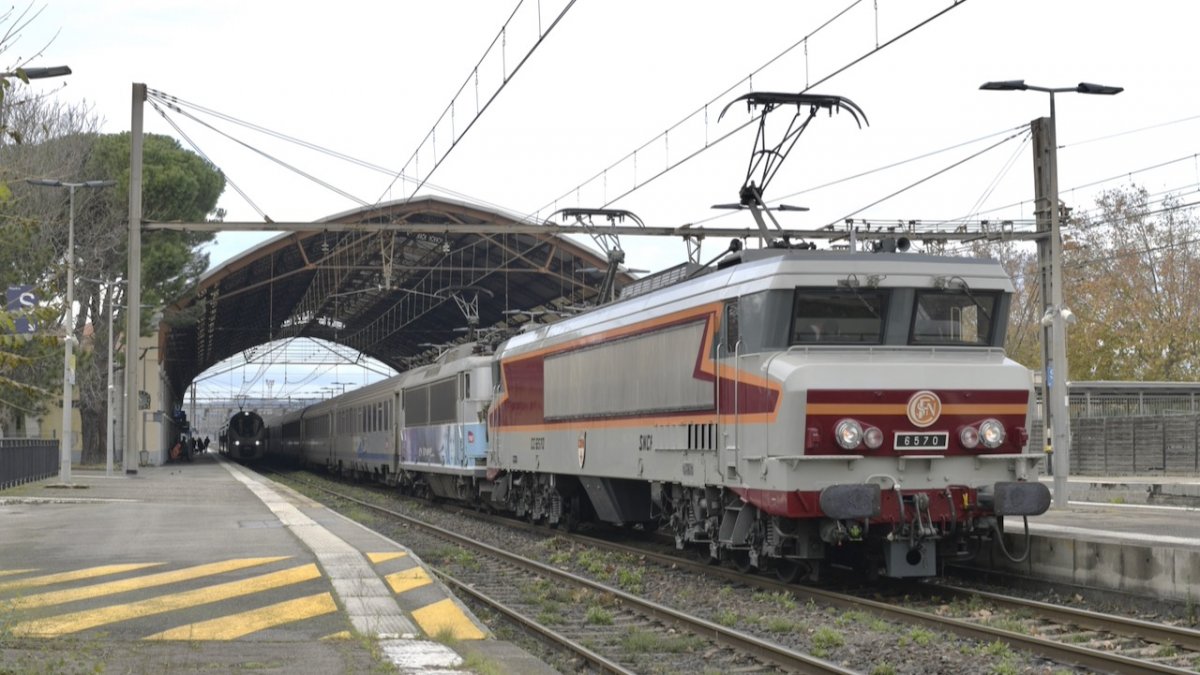
The annual Fête des Lumières took place in Lyon on 6 December. Three preservation societies ran special trains: CC 6570 and BB 25639 from Avignon, X 2816 and remorque Xr 6154 from Besançon, and a BB 67400 and RRR sets from Clermont-Ferrand. The APCC special is seen above waiting to leave Avignon Centre, the first time that CC 6570 has operated for three and a half years.
The following day, Sunday 7 December, the Santa Special season was underway on a number of preserved railways. AJECTA ran a Santa Special on the main line from Longueville to Romilly with 140 C 231 and BB 63855. The return is seen below in the twilight near Hermé with 140 C 231 in the lead. Photos: Jean-Louis Poggi.


An exceptional event took place on Saturday 13 December when AAPSL organised a special from Paris to the Christmas market at Amiens formed of BB 17016 and the MFPN rake of coaches. With lighter Saturday traffic on RER E, the special was able to start from Haussmann – Saint-Lazare. Seen above after arrival from Le Bourget and Vaires, the train then served the new Nanterre-La Folie station before taking the Bezons connection to Line E tracks, the first passenger train to use it before the Eole line opens to the west, scheduled for 2027. Photo: Christophe Masse.
Urban
A 4km eight-stop extension of Strasbourg’s tram Route F from Comtes to Wolfisheim Henri Rendu, built at a cost of €122 million, opened on 15 November. The extension passes through an area of new housing terminating at a park and ride facility. At the same time, the first of 39 Citadis 3 trams entered service, seen here on 10 December; they are being supplied by Alstom to replace Socimi/ABB Eurotrams dating from 1994.

RATP is taking further measures to counter delays caused by objects left on trains or platforms following a 27% rise in such incidents last year. On police advice, only items assessed as obviously dangerous, by presence of wires, batteries, gas canisters or a threatening message, will lead to evacuation of train or platform. Trains are now permitted to run non-stop through a platform where a package has been identified as non-suspicious, or are diverted to a turnback siding if the package is onboard. Unions described the changes as ‘a danger to staff and passengers’. Photo: Le Parisien
For those with no pass, the €2 bus/tram fare now applies on all Paris tram routes. This eliminates the anomaly created when tariffs were simplified a year ago whereby the €2.50 metro/train flat fare applied on routes T4, T11, T12, T13 and T14.
Replanning of timetables on Lines 5, 9, 11 and 12 takes account of post-covid changes in travel patterns, as traditional peak-hours are no longer the busiest. Line 5 will see increased frequency all day, whilst the others will have extra trains at the new busy times, such as between 20.30 and 00.30, and at weekends.
Orlyval. An agreement was signed on 20 November between the State, Aéroports de Paris and ÎdFM to provide €1 million for studies on the future of the Orlyval shuttle linking Orly airport with Anthony station on RER Line B. Since metro Line 14 reached the airport in 2024, use of Orlyval has plummeted. It now seems likely that the alignment will be reconfigured to serve new airport parking areas and other internal locations, but the cars and operating system are life-expired and would cost several hundred millions to renew. A decision will be taken in six months’ time.
Châtelet. Mentioned here last month, the three travelators will be out of service at least until summer while the 2,400 treads are replaced.

GPE. The first running trials on Line 18 took place over the weekend of 20-21 December, a train seen here on the RN118 viaduct in Yvelines. With work on the initial section of Line 15 suffering delay, Line 18 will now be the first to open, probably in October. Line 15 opening is now scheduled for April 2027.
Villejuif-Gustave Roussy station on Line 14 has been voted ‘most beautiful station in the world’ by the Prix de Versailles. It will also serve GPE Line 15 when the first section opens later this year.
Photo: Société des Grands Projets.

Bordeaux. The consultants’ report into the city’s metro proposal (see May 2025 News) finds that the 18km automated line would be ‘technically feasible, would cost of €2.7 billion, and would have a poor cost/benefit ratio’. The report was considered by the Métropole on 18 December and will be an issue in March’s municipal elections. An alternative put forward by opponents would be ‘optimisation’ of the existing tram network, raising capacity by lengthening trams and easing pinch points such as the junctions at Porte de Bourgogne (see below).

Two new tram routes were introduced on 6 December: Line E from Blanquefort to Floirac-Dravemont and Line F from the airport to Gare Saint-Jean and Bègles. Peak-hour frequency on the busiest section of Line A, between Hôpital Pellegrin and Cenon, was raised from 17 to 24 cars/h. Media reports described the first few days’ operation as ‘chaotic’, with breakdowns, lengthy intervals between cars, and congestion at the Porte de Bourgogne interchange. On the first day of the new services, a Line F car negotiates the crossovers at Porte de Bourgogne laid last summer to allow through running from west to south. Photo: John Bamforth.
Lyon. The TEOL Tramway Express Ouest project was approved by the commission of inquiry on 4 December and will now be submitted for its declaration of public utility. The line should open in 2032.

Toulouse. Tisséo is to undertake mid-life renovation of the 14 VAL 208AG trains on Line A. Dating from 2003, they will have their lifespan extended to 2048. Six months of dynamic trials of the first car for Line C began on 5 December at the CEF Valenciennes test centre. A second car is undergoing homologation in Poland. A big effort is underway to recruit 175 new tram and bus drivers, and metro maintenance technicians.
Montpellier The city’s M’Ticket app now includes an SOS button allowing passengers to seek immediate assistance discreetly in the event of harassment or aggression. Photo. TaM.
Amidst great celebrations Line 5 linking Clapiers and Grés de Montpellier opened on 20 December, when 24 out of the city’s 40 bus routes were reorganised. Trams run every 12min until 26 February, then every 10min, and every 7min from the start of the 2026-27 school year in September. Line 5 will have 22 of the 77 Urbos cars on order from CAF. Photos below :Gazette Live Montpellier


© Peter Lovell & Chris Bushell. The French Railways Society 2026. With thanks to Georges Turpin, Christophe Masse, Jean-Louis Poggi, John Bamforth and Didier Delattre