
March 2026 News
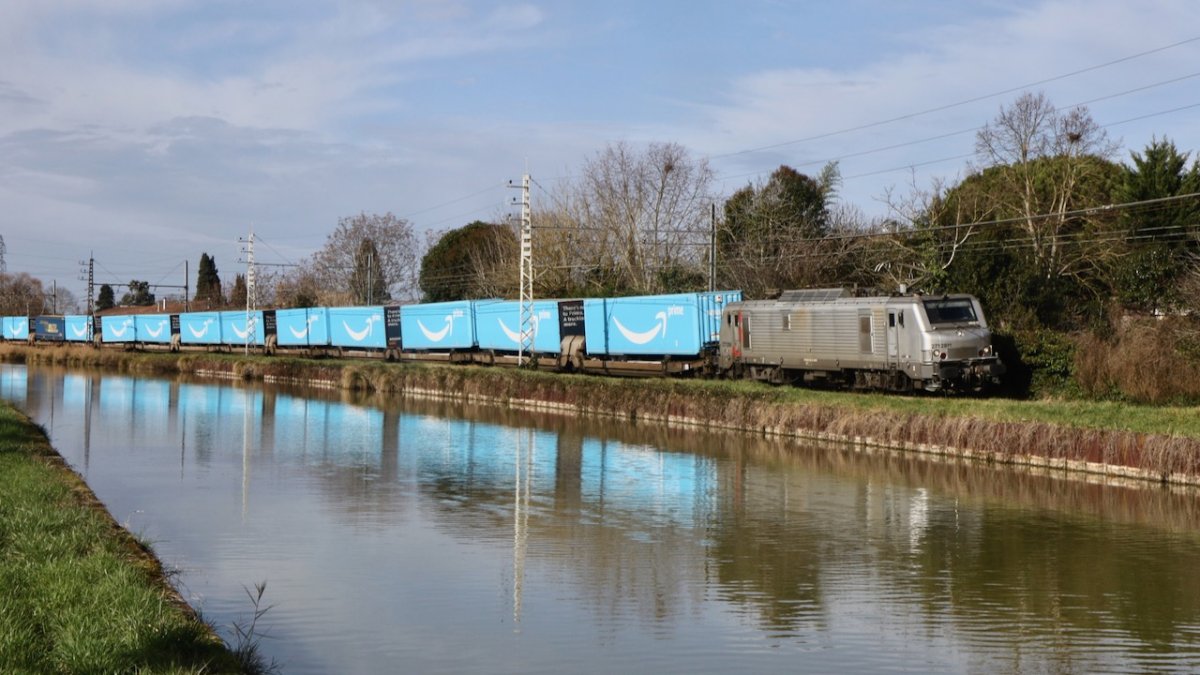
Amazon Prime delivery. Akiem BB 27128 currently operated by Captrain passes Pompignan, north of Toulouse, on 30 January with Train 43974 Mouguerre – Woippy – Bettembourg. The service is operated by Lorry-Rail, a joint venture between Rail Logistics Europe rolling motorway subsidiary VIIA and Chemins de Fer Luxembourgeois. The service was introduced in October from the Brittany Ferries terminal at Mouguerre (Bayonne), running via Narbonne and the Rhône Valley, providing a link from Portugal, Spain and southwest France to the Benelux countries, Germany, Eastern Europe and Scandinavia. Initially operating two return services a week, since mid-November this has increased to four. Each service can carry up to 24 semi-trailers and 22 containers on Modalohr wagons. Photo: Georges Turpin.
Akiem agreements with Technis and Naviland
Technis, the former locomotive maintenance arm of Fret SNCF, will undertake planned and corrective maintenance of Akiem's BB 27000 and BB 37000 fleets operating in France. Major examinations will take place at Lens, Thionville and Dijon Technicentres as most of the traffic is on the Luxembourg – southeast France axis. Routine maintenance will be undertaken at first-level maintenance sites at Le Havre, Modane, Miramas, Perpignan and Bayonne. The agreement also covers other work such as mid-life overhauls.
In a separate agreement Naviland Cargo, the maritime container arm of RLE, has extended its leasing arrangement with Akiem for a further seven years. This covers provision of 14 class BB 27000 locomotives including maintenance.
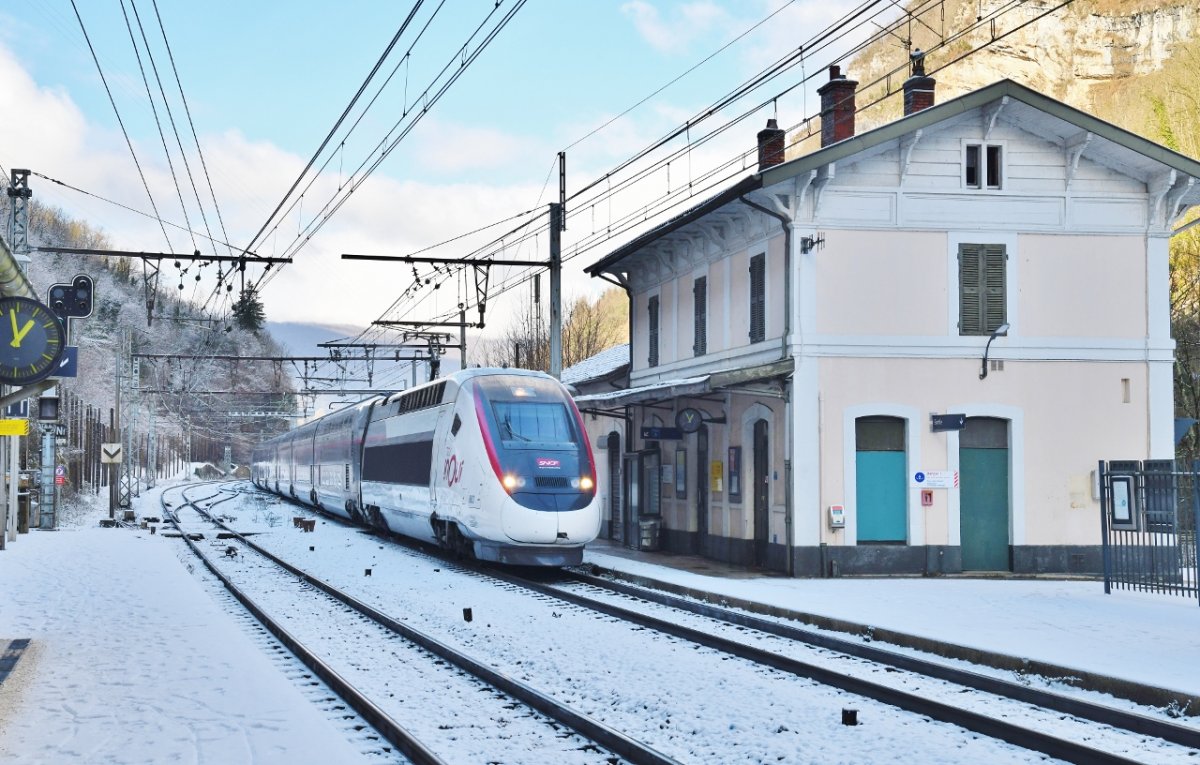
On 11 January an Inoui Euroduplex set heads through Tenay-Hauteville between Ambérieu and Culoz with TGV 6429 08.52 Gare de Lyon – Bourg-Saint-Maurice. Photo: Pierre Julien.
Record winter holiday traffic
This year resources were found for an additional seven departures to Tarentaise valley destinations on Fridays, making 21, and nine extra returns on Sundays. Saturday service, already operating at maximum capacity, was unchanged. The additional trains, along with doubling of sets on some services, provided 16,000 extra seats. In addition, Ouigo Grande Vitesse runs to Bourg-Saint-Maurice daily until 28 March, and the Paris – Briançon night train had extra coaches until 3 March. The Travelski Night Express (see January News) provides a further 660 places, running Paris – Bourg-Saint-Maurice until 20 March, out Friday nights, returning Saturday nights.
Before the holidays ended, SNCF Voyageurs was claiming a record number of passengers, with 10 million tickets sold, a 4% increase over 2025 which was itself a record year. Over the five weekends covering the three nationwide holiday periods, 850 TGVs ran to Alpine destinations, mostly to Bourg-Saint-Maurice over the 80km of single track from Saint-Pierre-d’Albigny that includes reversal at Albertville.
For those interested in discovering more, veteran writer Bernard Collardey covers the history and development of Trains des Neiges in the January issue of Rail Passion.
On Saturdays from mid-December until the end of March Eurostar operate 'Snow Trains' from Brussels to Bourg-Saint-Maurice, returning on Saturday afternoons and Sundays. Below. As evening closes in along the Maurienne Valley on the 10 January a Velaro e320 set forming Eurostar 9928 10.32 Brussels – Bourg-Saint-Maurice passes a lone dog-walker and approaches the junction of the Modane and Albertville lines at Saint-Pierre-d'Albigny. Photo: Pierre Julien.

Storm damage report
During February a succession of storms swept across France with heavy rains and strong winds causing numerous incidents as the network reacted to high winds and intense rainfall following periods of prolonged drought. With parts of Spain heavily impacted by Storm Leonardo, flooding damaged a tunnel outside the port of Barcelona, causing further delays to cross-border freight movements in the first week of February (see February News). As before, trains were held on both sides until the route was cleared.
As the middle of February approached the storms continued to roll in, their names now coming from the second half of the alphabet.On the advice of Météo France, SNCF’s Stop Circulation preventative measures were widely applied, bringing services to a standstill as winds reached over 100km/h. Storm Nils on 11 February bought high winds and saw a tree fall on to the cab of a Z 20500 unit south of Étampes; evening services around Toulouse cancelled. The following day most trains were suspended between Paris and Toulouse and many lines in Occitanie and Nouvelle-Aquitaine were disrupted by fallen trees. The rain returned with Storm Oriana on the 14th, followed by Pedro on the 18th. Lines not affected by flooding or fallen trees faced the risk of landslides. The following items are illustrative of the numerous incidents that occurred.
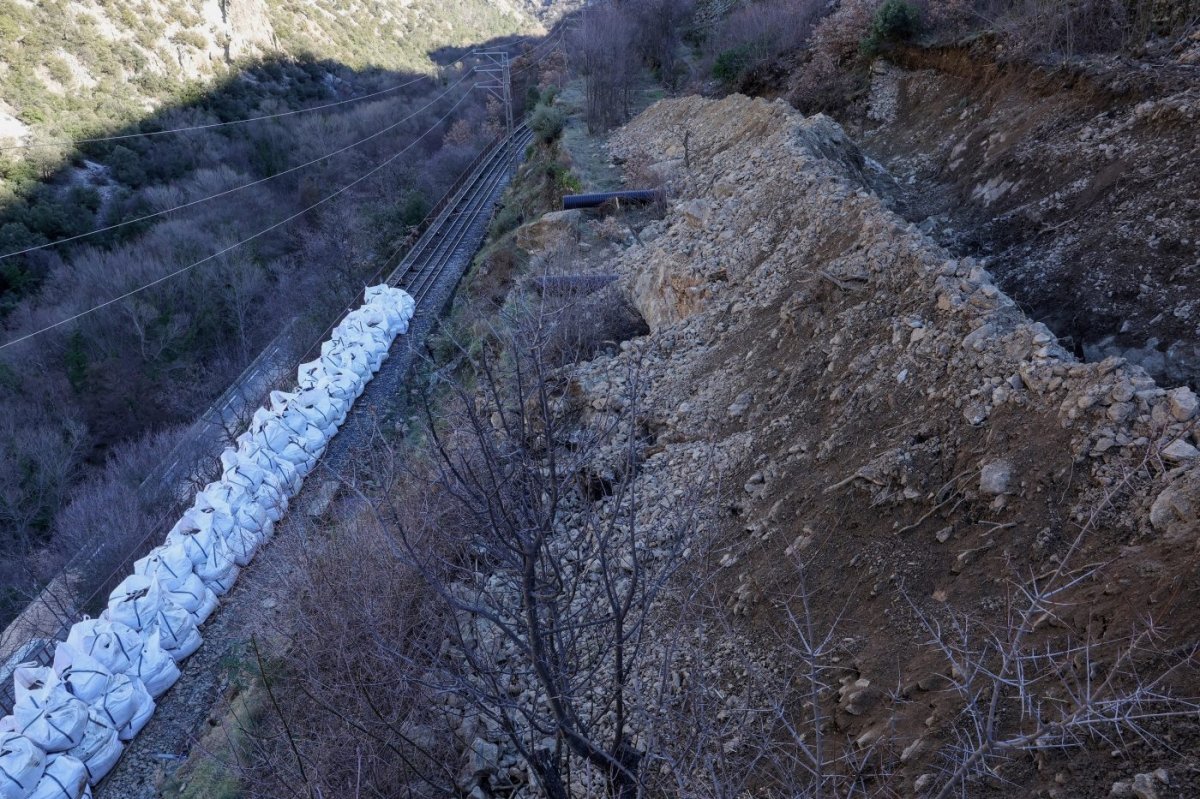
Train Jaune resumed operation on 7 February, though only between Latour-de-Carol and Mont Louis La Cabanasse, with two A/R daily. The initial rockfall at Thues-Entre-Valls (see February News) appears to have been cleared but large bags of ballast have been stacked along the track to act as a retaining wall from further landslides and protect the RD 66 below. Photo: Dis-Leur.
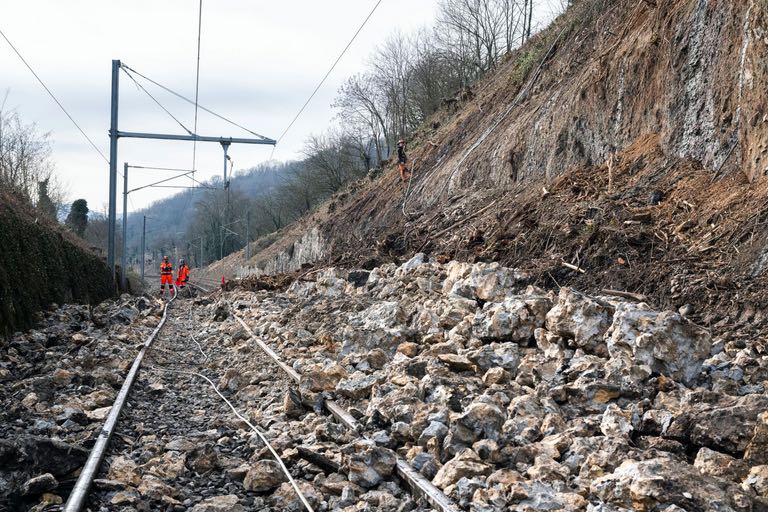
No trains ran between Saint-Marcellin and Moirans on the Valence – Grenoble after a landslide at Poliénas on 29 January. Originally scheduled to reopen on 9 February, SNCF later said that remedial work would be completed ‘by mid March’. An hourly TER was running from Valence to Saint-Marcellin, and AURA région put on fast buses from Grenoble to Valence. Photo: SNCF Réseau
Particularly affected was the line from Toulouse to Latour-de-Carol. With the RN20 road to Andorra blocked by a landslide near Mérens-les-Vals and likely to be closed until May, Occitanie augmented rail service between Ax-les-Thermes, L’Hospitalet-près-l’Andorre and Latour-de-Carol from 2 February, with four additional A/R daily. A one-day strike on 7 February stopped all trains, leaving parts of the area completely cut off. Trades unions were roundly criticised for the stoppage, said to be the culmination of months of warnings about the degraded state of the line. Buses normally used for weekend Skirail connections were mobilised, carrying around 250 people on roads that remained open. From 9 February mail was loaded onto regional liO trains at Luzenac-Garanou and dropped off at Mérens-les-Vals and L’Hospitalet. Occitanie introduced a €1 fare for rail journeys between Foix and Latour-de-Carol as a gesture to help the local economy which has been badly affected by the road closure. The Latour night train was also cancelled or curtailed. By the 18th, heavy rain had caused subsidence further down between Foix and Ax-les-Thermes, with trains only able to operate between Ax-les-Thermes and Latour-de-Carol and buses providing a link to Foix. On 25 February, SNCF said the line would be closed for several months. With only one EMU available at Ax, SNCF could only operate the normal five trains each way and was unable to provide the additional services in respect of the RN20 closure.
On the 17th, a weakened section of track was identified between Montrabé and Gragnague on the line out of Toulouse carrying services to Albi, Rodez, Capdenac, Castres and Mazamet. The line was closed for two days with bus replacements before trains were reintroduced with a 10km/h speed limit over the damaged section. By the 20th things seemed to be improving. Gironde département moved from a red to orange flood alert although the Médoc line was closed when overhead power lines collapsed.
Étoile de Caen contract signed
Described by the région’s president Hervé Morin as “a decisive step for daily travel”, the new contract will see augmented services on seven routes. To Évreux there will be eight A/R daily, up from just one today; to Cherbourg the service doubles to 7 A/10 R; and Caen – Lisieux adds 14 A/R to become half-hourly throughout a longer operating day. Other routes will have one to three additional A/R. Total daily trains will rise by around 70%, with train-km increasing from 3.4 to 5.1 million. The Coutances and Saint-Lô routes will retain their current service of 12 and 13 A/R respectively, and the Trouville – Dives-Cabourg summer-only service is also unchanged.
Reliability will be improved: fewer cancellations and more effective replacement buses are promised, along with a commitment to maintaining connections during disruption. RATP will aim for 93.4% punctuality compared with today’s 91.8%. Other improvements to the passenger experience include 24h digital assistance and greater staff presence on trains (though not at stations). Refreshment service is to be provided on longer-distance trains.
As operator of Caen’s Twisto network of trams and buses, RATP Dev already has a strong presence in the city. This will be augmented with new offices, a recruitment drive, and partnerships with economic, industrial, academic and employment stakeholders. The offer to staff transferring from SNCF will be based on salary increases and clear career paths, aiming to retain skilled employees to ensure service quality. RATP Dev also plans investment to improve operational reliability, with new facilities and modernisation of Caen maintenance depot planned for 2029.
On 15 July 2025 X 73533 and another saucisson call at Lisieux with TER 852012 the 10.12 Caen – Rouen.
Photo: Florian Pépellin/CC-BY-SA 4.0.
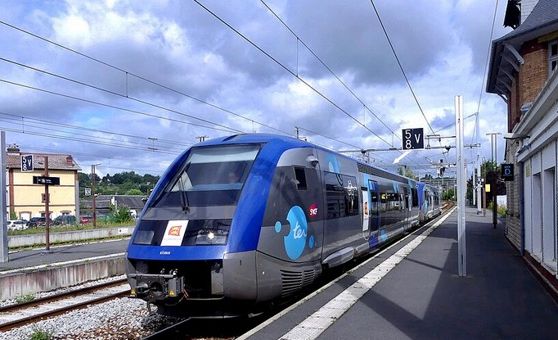
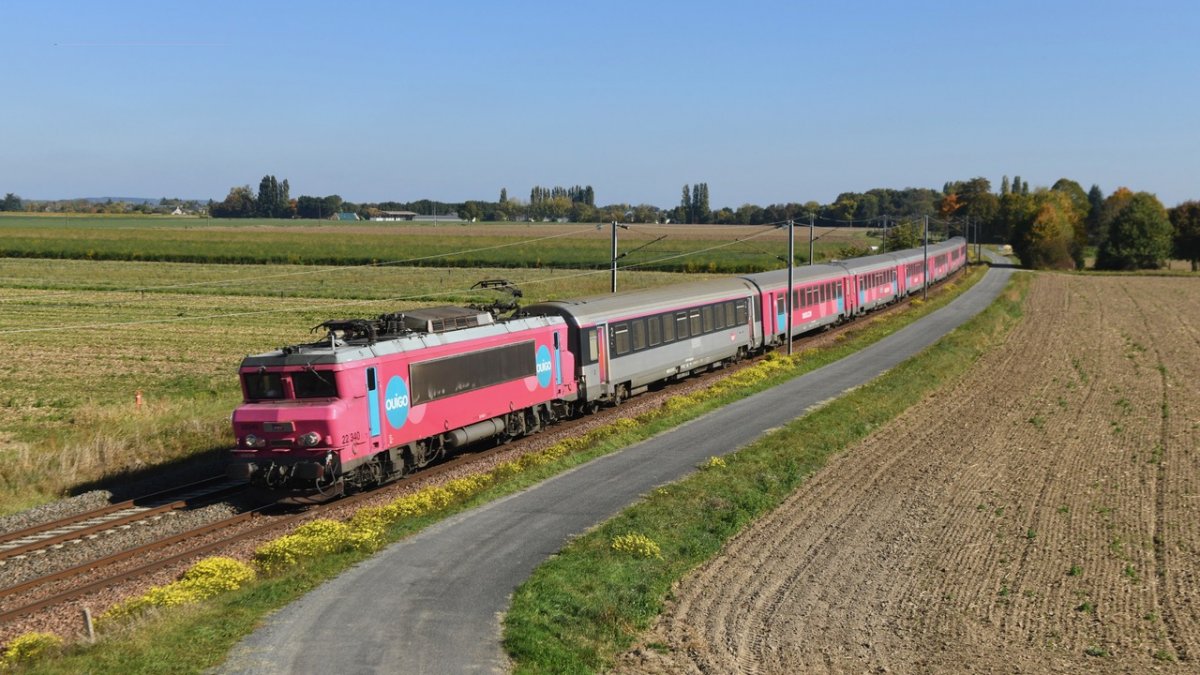
During 2025, due to engineering work north of Orléans, Ouigo Classique Paris – Nantes services only ran via Saint-Pierre-des-Corps and the Loire Valley at weekends, and were routed via Le Mans during the week. They have now returned to the Loire Valley on a daily basis with Le Mans now served by Paris – Rennes trains. On 12 October 2025 BB 22340 approaches Saint-Mathurin-sur-Loire with Ouigo 4087 the 11.42 Paris Bercy – Nantes.
Ouigo to Nancy, Classique to Bordeaux
To consolidate its position prior to the start of competing services in 2028, Ouigo Classique trains will be launched on the Paris – Bordeaux route on 4 April, the first departing Austerlitz at 06.35 for arrival in Bordeaux at 12.03. Trains run on Fridays and weekends from Paris Austerlitz or Bercy with stops at Les Aubrais, Saint-Pierre-des-Corps, Futuroscope, Poitiers and Angoulême, journey time around 5h 30. Trains 4021/4024 run A/R on Fridays, while 4022/4023 run weekends. One-way fares are from €10 to €59. SNCF hopes to attract 100,000 passengers to these trains in 2026, in addition to those using the five daily A/R Ouigo Grande Vitesse.
Commenting on the new services, Fnaut pointed out that the number of seats offered on Inoui trains had declined by 24% over the past 10 years as Ouigo has expanded, restricting the benefits offered to Carte Avantage holders whose 30% discount does not apply on Ouigo services.
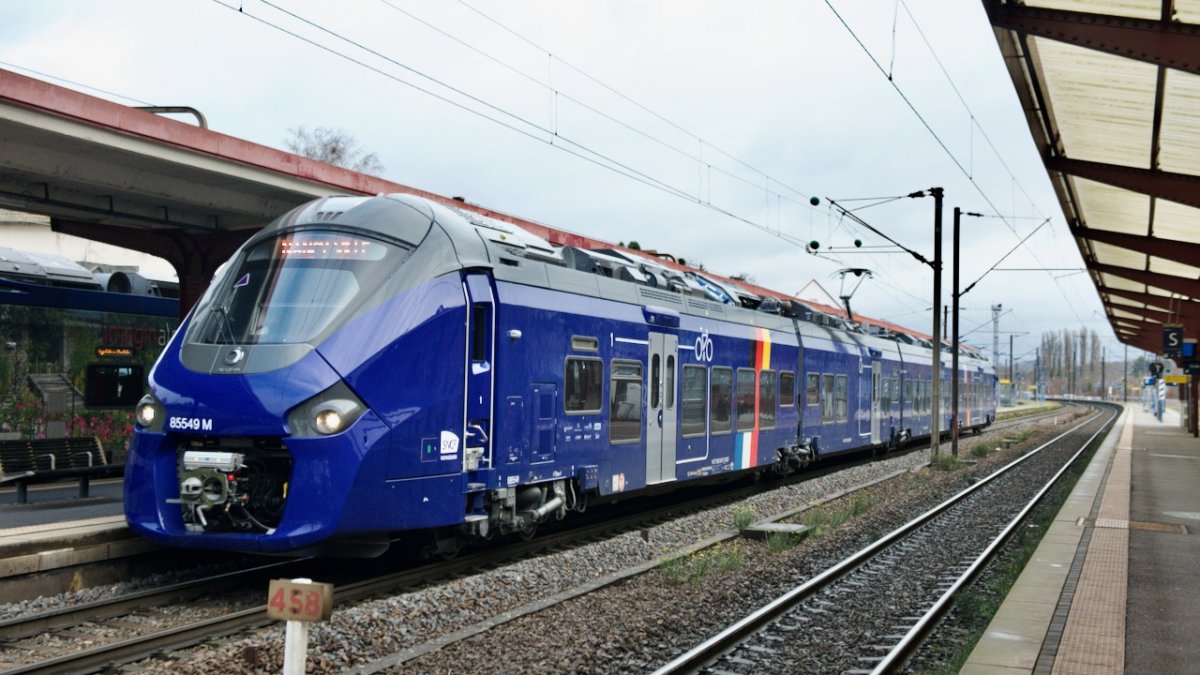
Whilst waiting approval to work into Germany, the B 85500s have been used extensively by Grand Est TER on services in Alsace, often covering for AGCs undergoing the Opter mid-life refurbishment programme. These have ranged from main line services from Strasbourg to Metz and Nancy to the branch lines to Lauterbourg and Kruth. Above. B 85549 pauses at Saverne on 3 December 2024 with the 11.10 Strasbourg – Nancy.
Feu vert for cross-border Régiolis
Grand Est’s 30 Régiolis MUs ordered in 2019 for cross-border service were finally approved for operation in Germany at the end of January. EBA, Germany’s federal office for rail safety, passed the trains for running in Rhineland-Palatinate, Saarland and Baden-Württemberg; the first will enter service in May on the Strasbourg – Offenburg and Mulhouse – Müllheim routes, 18 months later than planned. The fleet is currently deployed on GE domestic services to ease stock shortage; eventually the trains will operate Metz – Trier, Metz – Saarbrücken, Strasbourg – Saarbrücken, Strasbourg – Neustadt and Strasbourg – Karlsruhe.
The four-car B 85500 Régiolis variant is equipped for 1.5 and 25kV operation as well as diesel power. Delay in homologation arose because of changes to Germany’s regulations governing emergency braking following a number of accidents. This required alterations to the brake systems already fitted, reprogramming of onboard computerised control equipment, and a new round of trials. EBA’s approval has to be ratified by the three länder, expected to be no more than a formality.
The 2019 Transfrontalier accord provided for these cross-border services to be concessioned, but no agreement could be reached between GE and the länder until the whole fleet was in service. Now GE and the German authorities can seek bids for a private-sector operator who would be required to offer train crew passed to work in both countries.
The 2N NG Z 26500 trains bought from Normandie région will enter peak service next month on the Nancy – Metz – Luxembourg route, initially substituting for one of the current pairs of three-car X 24500 units. All are expected to be in service by 4 May, when peak-hour trains will be formed of 11 cars, pairs of Z 24500 and one five-car Z 26500. The peak-hour offer on this heavily-used route will thus rise to 11,200 seats. GE bought 16 2N NG trainsets from Normandie in 2019 but their transfer was delayed by slow delivery of replacement stock from Alstom (see item below), and then by the need to equip the trains for ERTMS and homologation for running into Luxembourg. GE expects to open this route to competition next year, with Luxembourg Railways (CFL) thought to be a potential bidder.
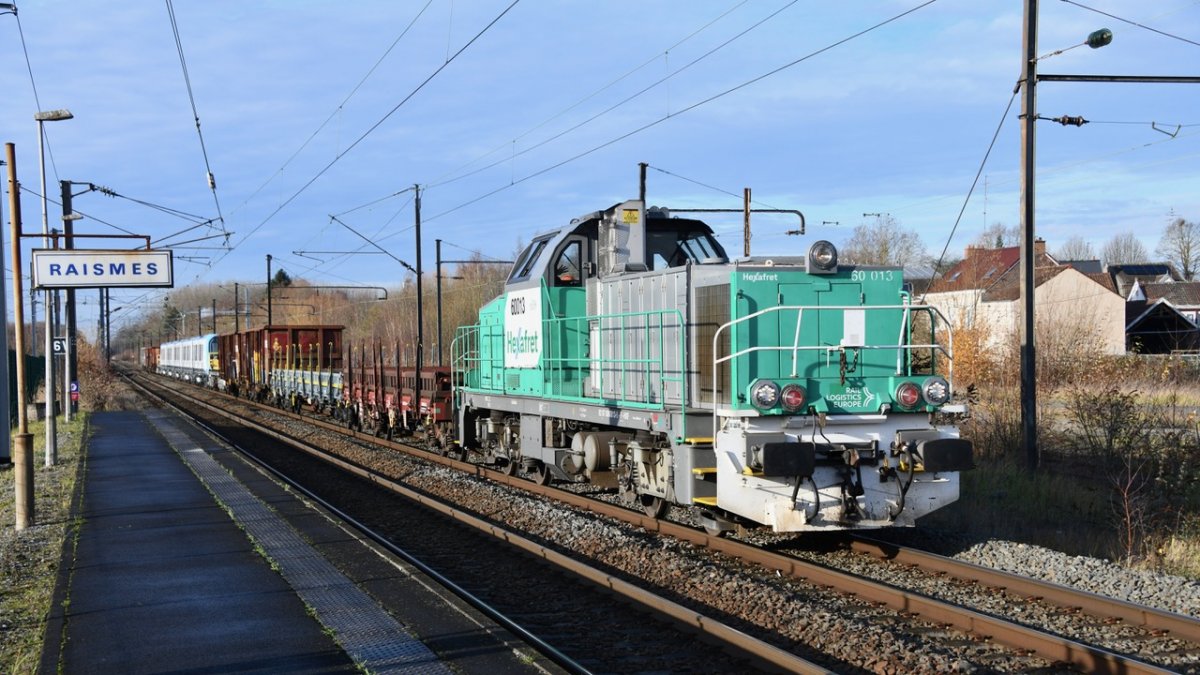
RATP MF19 007 leaves the Alstom plant at Raismes on the 16 December on the first leg of its journey to Paris, running to Valenciennes as Train 411117 behind BB 60013 and sandwiched between an assortment of freight wagons for braking capacity. Photo: Didier Delattre.
Late deliveries leak sparks anger
The leak highlights the role of the State, transport authorities and policy-makers in creating unrealistic deadlines and increasingly complex demands on rolling stock suppliers. Ironically, the report was delayed for several months’ due to the complexity of the issues investigated. The covid pandemic still casts a shadow but the report appears to pull no punches in criticising suppliers and clients; media coverage described it as ‘explosive’, hence the leak.
Alstom as the main supplier of rolling stock is singled out for poor organisation, management weaknesses, and lack of control of its supply chain, whilst continuing to bid for contracts despite a substantial backlog of orders and ongoing late delivery. It responded to the leak by saying ‘elements have been taken out of context for the sole purpose of designating a scapegoat, rather than nurturing the search for sustainable and effective solutions. This is clearly not the intention of the authors of the report’.
CAF comes in for less flak on account of its smaller presence in the French market, but its first contract to supply Oxygène trainsets is four years late, initially due to covid and then the widely-reported premature wear and vibration found on tests with the pre-series train.
SNCF is taken to task for working in silos and for the excessive complexity of its technical standards: a ‘culture of specification…and over-specification’. Other clients such as Île-de-France Mobilités and the régions are also charged with over-specification and demanding costly and time-consuming design changes after contract. Elected officials often specify unrealistic delivery deadlines for political reasons, the report said.
It is not known when or if the full report will be published.
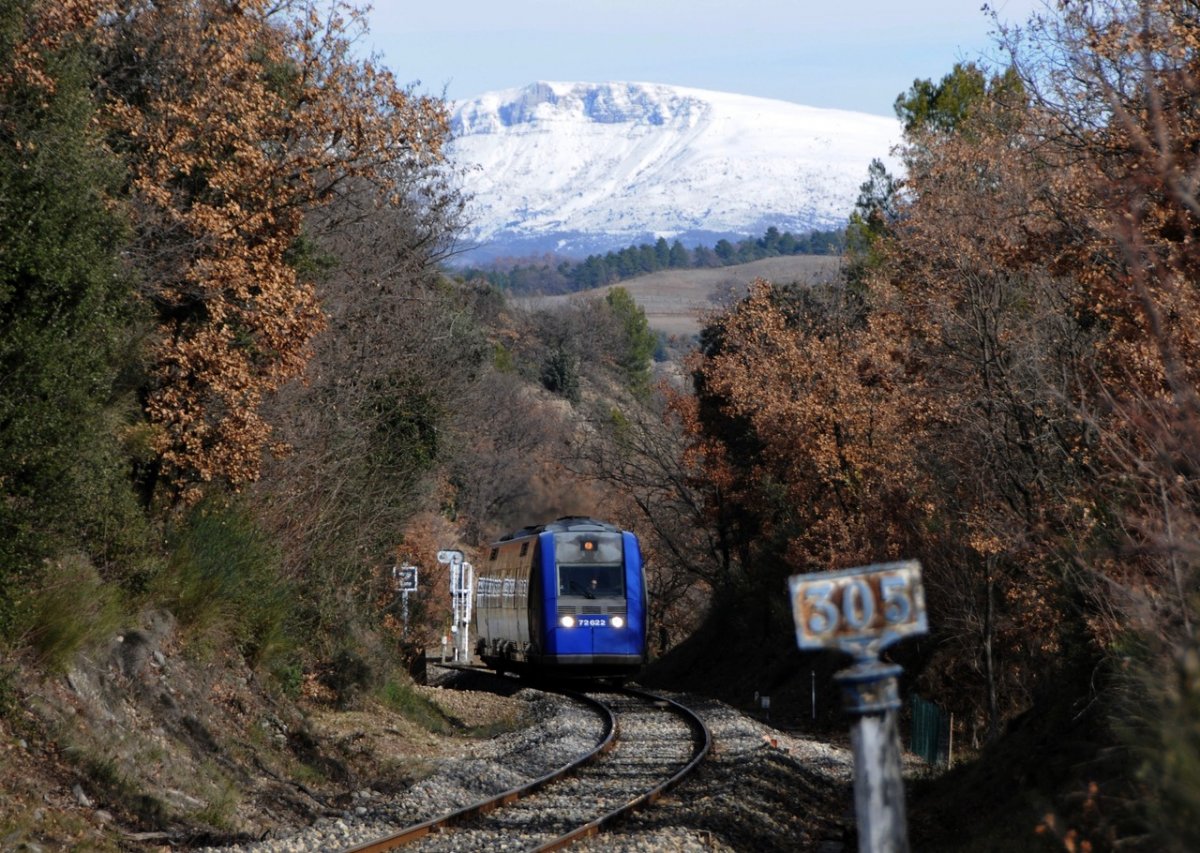
On 5 February, X 72622 is seen at Km305 just before the station at Château-Arnaud-Saint-Aubin south of Sisteron, running half-an-hour late with TER 17435 the 08.29 Briançon – Marseille. Photo: Philippe Leynaud.
Winter Olympics plan refined
The line last had a major upgrade 20 years ago. Apart from equipping the route and stations to handle the Olympics crowds, the work will secure the infrastructure for operation from 2029 by SNCF Voyageurs Sud Alpes Méditerranée, winner last October of Région Sud’s competition for Lot 3 Marseille Est. The contract promises 30% more trains at 30% lower cost (across the whole operation), a formula said to be contributing towards financing the Briançon line upgrade. One aim is to cut an hour from the current 4h 40min journey time of the three daily trains for two additional services running semi-fast, using new bimode MUs from the batch of 25 to be ordered by the incoming operator. The 33km between Marseille and Aix-en-Provence is electrified using discontinuous overhead.
● Over 100km of track will be replaced and remedial work carried out to eliminate speed restrictions, some as low as 40km/h, restoring 110km/h running over most of the route. Sections with steel sleepers will be replaced by concrete.
● Renovation of infrastructure at 80 locations, repairing damaged bridge and tunnel masonry, improving trackbed and drainage, stabilising cuttings and embankments.
● Reopening of passing loops at Savines-le-Lac and Laragne-Montéglin, both out of use for several years. An earlier proposal to reinstate a section of the former double track between Veynes and Chorges has been shelved.
● Replacement of obsolete manual block (BMVU) between Veynes and Gap, plus piecemeal upgrading of signalling and safety equipment elsewhere.
● Redevelopment, accessibility and safety works at Meyrargues (220m platforms); Gap and Embrun (new footbridges with lifts); Mont-Dauphin-Guillestre (PEM); and L’Argentière-les-Écrins stations to enable them to handle the expected Olympic crowds.
● Briançon station will be redeveloped as a multimodal interchange (PEM) to accommodate the winter sports crowds, with new footbridges and escalators at each end of the station. The maintenance depot will be modernised separately by the new operator.
Infrastructure works are costed at €328 million, Meyragues station €4.5 million, other stations €14.5 million, and Briançon’s PEM €14.5 million. Six weeks of outline consultation starts on 13 April prior to full public consultation at the end of the year. Work will start in mid-2027 for completion by December 2029 when SNCF Voyageurs Sud Alpes Méditerranée takes over operations, and in time for the Games opening on 1 February 2030.
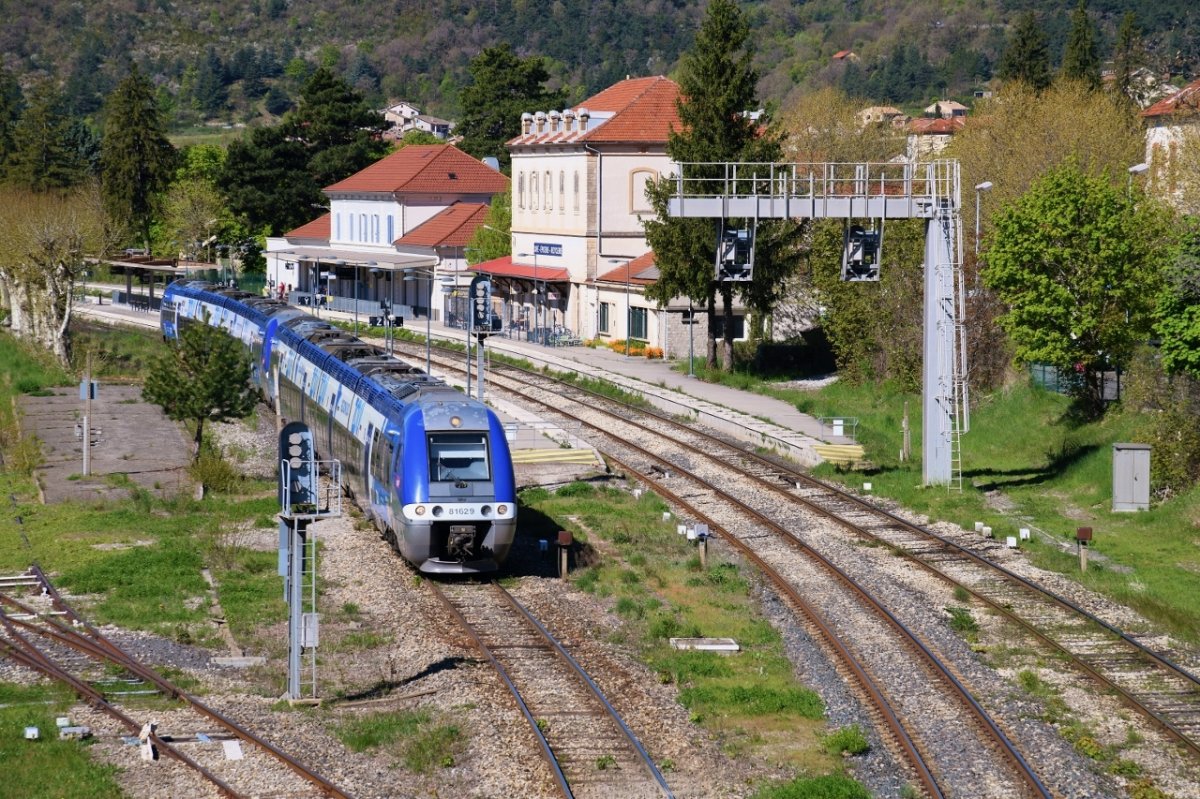
Below. At Veynes-Dévoluy on 25 April 2025, B 81629 leads B 81624 on TER 17402 the 07.41 Marseille to Briançon. Photo: Pierre Julien.
Switzerland’s cross-border worries
The Convergence 2026 project for reopening the Belfort – Delle line, to which the Swiss government and Jura canton had contributed €110 million, has come to grief, with Bourgogne-Franche-Comté région saying there were too few passengers to make the restored through service
worthwhile.
Trains from Belfort and its TGV station to Bienne in Switzerland were withdrawn last December. Instead, an hourly Belfort – Delle service provides a 5min cross-platform connection with Swiss trains and TGV connections are maintained at Belfort. A minor change according to BFC, but one which clearly rankles with the Swiss.
Also said to be in doubt are upgrades of the Besançon – La Chaux-de-Fonds and Pontarlier – Neuchâtel lines, the latter subject to dispute with BFC région saying that it has no responsibility for an ‘international’ route. On the La Chaux-de-Fonds Ligne des Horlogers, partially upgraded recently at a cost of €110 million to the French, gaps in the timetable leave workers in Switzerland with no train towards Besançon after 17.00. And the question remains of a further €50 million expenditure necessary to future-proof the line. The Doubs MP Matthieu Bloch drew attention to the convention signed in Paris a year ago for development of Franco-Swiss rail links, which is clearly not working well on the ground.
Also said to be in doubt are upgrades of the Besançon – La Chaux-de-Fonds and Pontarlier – Neuchâtel lines, the latter subject to dispute with BFC région saying that it has no responsibility for an ‘international’ route. On the La Chaux-de-Fonds Ligne des Horlogers, partially upgraded recently at a cost of €110 million to the French, gaps in the timetable leave workers in Switzerland with no train towards Besançon after 17.00. And the question remains of a further €50 million expenditure necessary to future-proof the line. The Doubs MP Matthieu Bloch drew attention to the convention signed in Paris a year ago for development of Franco-Swiss rail links, which is clearly not working well on the ground.

Engineering work on the traditional Paris – Strasbourg line between Château-Thierry and Châlons-en-Champagne will see services suspended until 16.00 on 1 March, 20/21 June and 5/6 September with a five day blockade from 13 – 17 May. Above. B 85075/76 passes Reuilly between Dormans and Château-Thierry on 25 July 2025 with TER 839106 Châlons-en-Champagne – Paris-Est. Grand Est operate a fleet of 24 Coradia Liners for long-distance services, mainly on Line 4, Paris – Troyes – Dijon/Belfort This is one of only three in blue and white 'Fluo' livery, the remainder being in Carmillon. Photo: Georges Turpin.
News in Brief
Three bids for NA Lot 1. Bids closed on 18 February for Lot 1 Poitou-Charente of Nouvelle-Aquitaine TER services opening to competition, comprising six services across four départements: Charente, Charente-Maritime, Deux-Sèvres and Vienne. As well as SNCF Voyageurs, offers have been received from Transdev and Le Train. Renfe had been reported as a likely contender, but in the event did not bid. The contract is for 10 years starting in December 2027; the winner will be announced this summer. The services are: Angoulême to Poitiers, Bordeaux and Royan; La Rochelle to Poitiers and Bordeaux; and Niort – Saintes – Royan.
RER Line Y trains sought. Île-de-France Mobilités called tenders on 18 February for 52 EMUs to work the new RER Line Y (as forecast in January News) which is to be separated from the existing route structure of Line C. This constitutes the first part of a framework order for up to 300 EMUs for Lines C and Y. To be designated Z2N NG, the trains will be similar to the NG stock currently being supplied by Alstom, with variations to take account of Line C’s restricted loading gauge, platform height and power supply.
Trenitalia ordered a further 74 Frecciarossa high-speed trainsets from Hitachi on 11 February, intended as the building blocks of a European high-speed metro its CEO said. The trains are capable of operating in France, Spain, Germany, Austria, Switzerland, the Netherlands and Belgium. SNCF Voyageurs has said that Italy will be targeted in its next phase of expansion outside France.
Having not sought access to London’s Temple Mills depot in last year’s bidding Heuro has abandoned its Channel Tunnel ambitions to concentrate on the Amsterdam – Paris route where it proposes an hourly high-speed service of ‘modern single-deck trains’ starting in 2030. Access rights have been agreed ‘subject to finalising contract negotiations’ and a ‘train and maintenance concept defined’, including a depot at an undisclosed location. Heuro is seeking funding of €750 million (€300 million equity, €350 million debt); minimum investment is €250. Amsterdam – London via Brussels remains a long-term aim.
After trials on the Paris – Lyon – Marseille route, SNCF Voyageurs is to extend six-months-ahead reservation for TGV Inoui services to the rest of France. The move will allow booking of summer holiday trains in early spring, at the same time as many people arrange accommodation.
Magalas station, between Béziers and Bédarieux on the Aubrac line, is to be a multimodal interchange (PEM), with the building rehabilitated as a tourist office, cycle hire base and automated food court. A previous project was abandoned in 2024. At Varilhes, between Pamiers and Foix on the Toulouse – Latour-de-Carol line, a PEM was opened on 23 January.
The State is to take a €50 million stake in the lithium mine being developed by Imerys near Echassières in Allier département. The project depends on upgrading the Gannat – Montluçon line to carry 34,000tonnes of ore per year.
The State is to take a €50 million stake in the lithium mine being developed by Imerys near Echassières in Allier département. The project depends on upgrading the Gannat – Montluçon line to carry 34,000tonnes of ore per year.

Preparatory work started in January for the €26 million replacement of the Vilaine river bridge east of Redon station. The new structure will be installed during a possession from 24 to 30 October. Photo: Georges Turpin.
Eurotunnel has begun the first phase of its signalling modernisation programme for interoperability and accessibility of new-generation of Channel Tunnel trains by installing ERTMS and ETCS. This concerns onboard signalling for the 57 Brush-built locomotives used on LeShuttle services. Cie des Signaux (CSEE) will supply a new signalling and control system for transition from the current TVM (track-to-machine transmission) system to ETCS. CSEE has developed a dual ERTMS/TVM standard to facilitate the transition and minimise locomotive downtime. Later phases will address upgrades to the ground infrastructure so that it can support full communication with the new onboard systems.
Régie TMB, the new operating company for Tramway du Mont Blanc, was incorporated on 28 January. It will take over management from Cie du Mont-Blanc on 18 May.
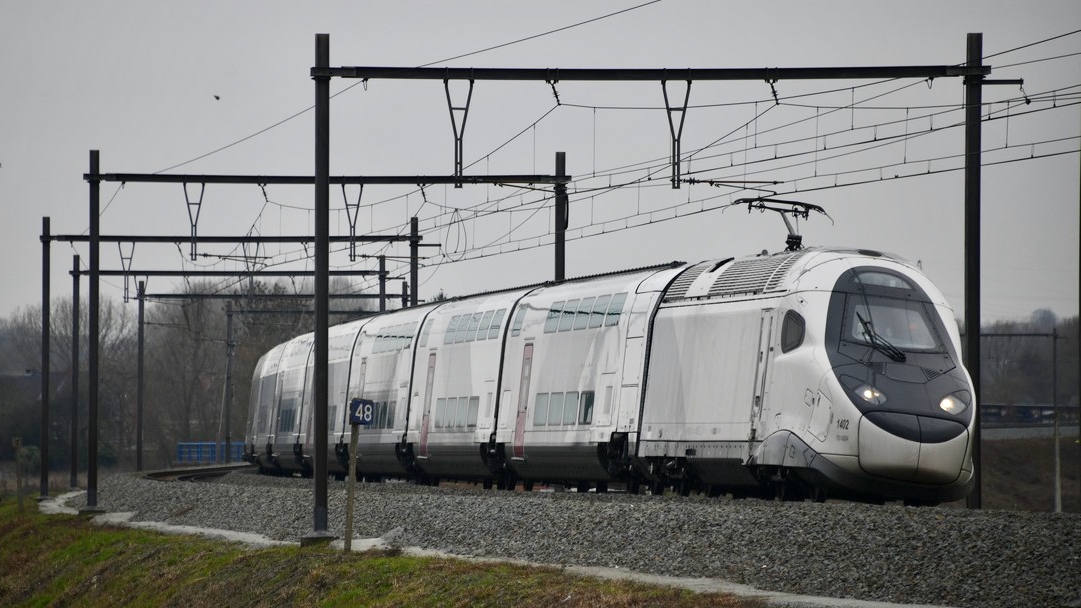
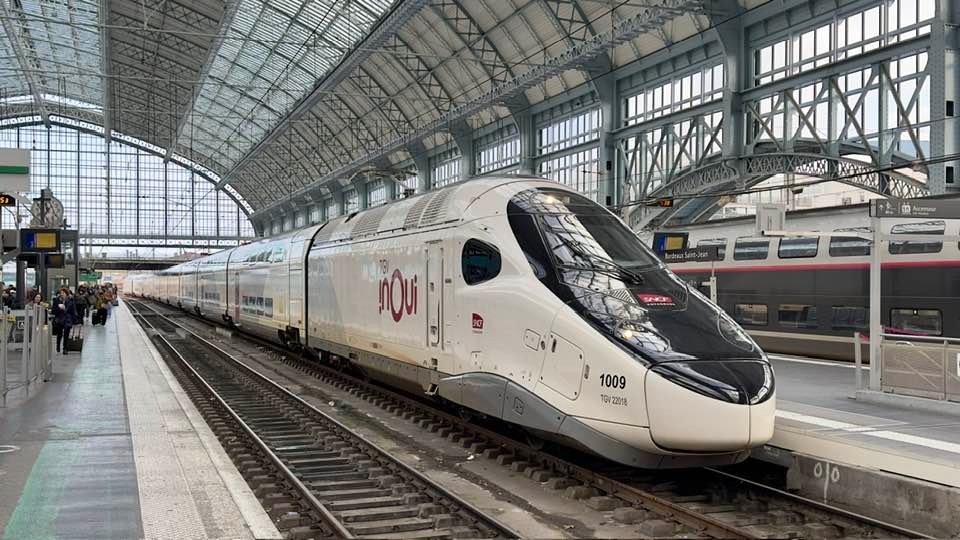
TGV Ms spread their wings. On 9 February trials of a four-current TGV M took place in Belgium, running on 3kV power between Ath and Le Coucou. Thirty are on order for service with SNCF Voyageurs Italia, numbered 14XX. Left. Set 1402 is seen leaving Ath. Photo: Didier Delattre. Pre-operation trials of the domestic version (bi-current) started on 12 February between Saint-Pierre-des-Corps and Bordeaux, carrying volunteer SNCF staff as passengers to test every aspect of the train's internal fittings and operating parameters. These trains are numbered 10XX and 100 sets are on order. Public service with the first four trains starts on 1 July between Paris and Marseille. Right. Set 1009, the first TGV M to arrive at Bordeaux Saint-Jean. Photo: Christophe Masse.
VSOE. A tour runs for the first time on 4 May from Paris to Pompeii and Ravello on Italy’s Amalfi coast, three days starting at €10,000 per person for one night onboard the train, two nights in an hotel. Return to Paris is not included in the price.
Le Mans. SNCF’s new training centre will admit its first students on 9 March following transfer of equipment and facilities from the old Technoparc site nearby. Nearby hotels are delighted that the new building can only accommodate 70 of the 200-or-so weekly students.
Calais. Phase 1 of the Voie Mère de Calais port railway modernisation, completed at a cost of €20.6 million, was officially inaugurated on 11 February, comprising track renewal between Calais Maritime and quai de la Loire, replacement of the pont Mollien, level crossing improvements and installation of noise mitigation measures.
Solar track. SNCF has signed an agreement with Swiss start-up Sun-Ways to access data from its three-year trial of in-track solar panels at Buttes on the Val de Travers line in Neuchâtel canton. SNCF will assess the feasibility of such installations on the French network, in particular how they might affect maintenance procedures.
Bourgogne-Franche-Comté. Remedial work on the Ligne des Hirondelles will be carried out between April and June, as will upgrade of the Clamecy – Corbigny section of the Morvan lines (not in 2027 as we said last month). Both are funded by BFC’s emergency subvention agreed last November.
Upgrading starts shortly on the private siding from the PLM main line at Gron, south of Sens, to the Yonne river port being developed by LogiYonne as a logistics hub. Currently serving Ynovae grain silos, the siding is to be rebuilt for 2,000tonne trains of 750m length, starting in autumn with two trains a week from Rotterdam carrying food products destined for processing at nearby Villeroy. The €6 million cost is being shared between LogiYonne, BFC région and the State.
SNCF opened its worksite at Chagny on the night of 3/4 February to show stakeholders progress on the €10.5 million project to replace 10 turnouts and modernise signalling at this junction on the PLM main line. This is the second stage of upgrading in the area begun a year ago. Work continues overnight on weekdays until 17 April.
Cherbourg. Trains resumed running on 5 February when the Down line past the derailment site at Carentan (see February News) was reopened. First departure was TER 3302 to Paris at 05.41. The damaged Up line is scheduled to reopen in mid-March.
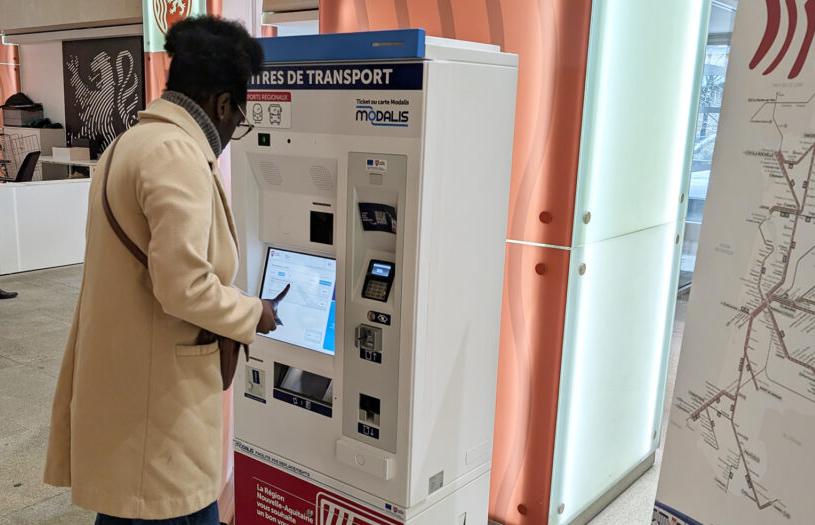
Nouvelle-Aquitaine. The new Modalis ticket machines mentioned last month are now in service at Pessac, Talence-Médoquine, Dax, Limoges and La Souterraine as well as Bordeaux Saint-Jean. Eventually, there will be 190 machines at 174 stations selling multimode tickets valid for TER, bus and urban journeys throughout the région. Photo: Région Nouvelle-Aquitaine.
Since 6 January, TR Trans Rail has been operating grain trains for Granaagro Deutschland from silos in Bourgogne to UFA (animal feed) plants in Switzerland; trains run weekly depending on demand. Europorte provides traction in France, while TR Trans Rail takes over at the Basle border for onward haulage. Granaagro Deutschland has leased 70 grain wagons from Wascosa for this traffic.
Six lightly-used stations on RER Line B are trialling RATP’s LIVA system (Lien Interactif avec Votre Agent) in which passengers access assistance by scanning a QR code with their smartphone, putting them in video contact with staff at the operations centre who could help with ticket purchase for example. The three-month trial involves withdrawal of station staff. On Line A, some stations will have only a single staff member on duty after 22.00.
Gare de Lyon. The first weekend in May will see SNCF Réseau install computerised signalling in the underground station and approaches, part of a long-term scheme begun in 2017. At the same time, new access tracks will be commissioned to serve the Villeneuve Demain Technicentre where a new heavy-maintenance depot for RER D and Transilien Line R trains opens later this year. The station will be closed from 30 April at 20.00 until 3 May at 14.00. About 60% of scheduled TGVs will run, diverted to Montparnasse, Gare de l'Est, Roissy CDG, Marne-la-Vallée – Chessy, Pont de Rungis and Versailles Chantiers. Trenitalia has not opened reservations for the period as it was unclear where (or if) its trains would be accommodated.

A new underbridge was completed on 30 January to replace PN4 at Deuil-Montmagny station on Transilien Line H in the northern suburbs of Paris. With 200 trains daily and 70 accidents in the past 15 years, the level crossing has been called the most dangerous in France. It will close next year once road works have been completed and a pedestrian underpass built at the station. Total cost is €50 million. Photo: SNCF Réseau.
RER Line E. Z 22500 MI2N trains that have operated Line E since 1996 will be withdrawn by the end of this year, ÎdFM said, with commissioning of the last of 60 Z 58000 NG sets from Alstom.
Île-de-France Mobilités issued its second Green Bond on 26 January, raising €1 billion for low-emission transport projects designated according to EU regulations. By 2030, ÎdFM hopes to have reduced greenhouse gas emissions by 25-30% compared to 2019 levels.
Gare du Nord. In the latest stage of the long-running legal battle over cancellation in 2020 of a modernisation project, SNCF Gares et Connexions is to appeal against a court order to pay €374 million compensation to the concessionaire Gare du Nord 2024.
Elected officials met SNCF PDG Jean Castex in Paris on 5 February to discuss the Bordeaux – Périgueux – Brive line which is awaiting track works and resignalling between Niversac and Terrasson (43km, single track), costed at €130 million. Line speed was cut from 115km/h to 100km/h last July and a further reduction to 80km/h is expected later this year if remedial work is not carried out.
The 8km branch from Fleury-les-Aubrais to Marigny-les-Usages, stub of the former line to Montargis, reopened last month after renewal of track and infrastructure at a cost of €10.6 million. Some 90 trains per year serve the Mars pet food factory at Marigny.
The environmental impact report on extending Rhône Rive-Droite Avignon – Pont-Saint-Esprit trains to Le Teil in Ardèche (see January News) finds the cost/benefit to be 'highly negative' due to the low patronage forecast and insufficient incentive for modal shift, which actually lead to an increase in CO2 emissions; 25% of passengers are expected to transfer from their cars, a figure considered too low. The three-month public consultation period closed on 24 February. Part of Le Teil station is being renovated to provide four commercial units in a €1.1 million project.
The prototype Ferromobile autonomous road/rail vehicle, converted from a Peugeot e-Traveller van, arrived at Olliergues in Puy-de-Dôme département on 16 February, and was presented to the public the following day prior to running trials over the Livradois-Forez Railway between Courpière and Vertolaye.
Ferromobile will accommodate up to eight passengers and is one of the Ademe-funded projects for development of lightweight vehicles (see July 2025 News) to revive moribund rural railways at lower cost than with conventional rolling stock. It would offer on-demand service, running on roads to town centres or individual addresses. Photo: Ville de Olliergues.

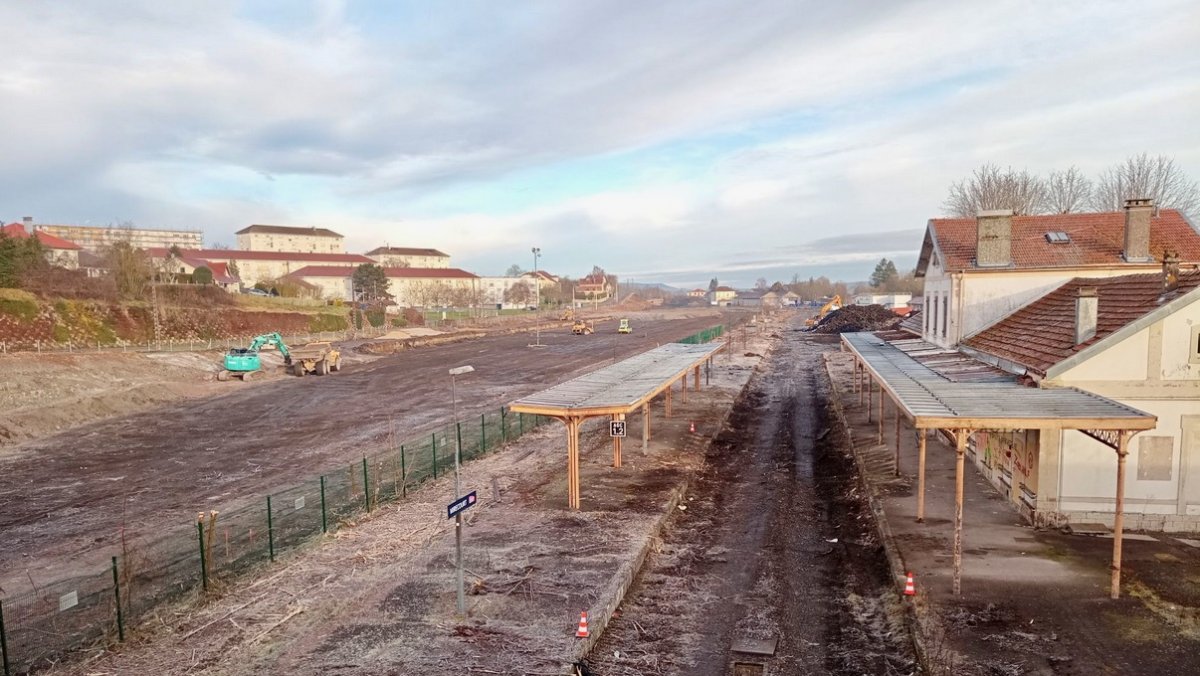
Grand Est’s ‘daring’ project underway
Demolition of redundant infrastructure began on 17 December after the final administrative approvals had been granted. Contracts have been awarded for the main elements of the project, utilising locally-based firms wherever possible. Recycled-steel rail is coming from Saarstahl at Hayange; concrete sleepers from Sateba at Charmes; ballast from quarries at Raon-l’Étape; and Vossloh rail fastenings manufactured at Reichshoffen, all located in Grand Est. Recovered timber sleepers will be burnt at the Novawood biomass power station at Nancy, and 18,000tonnes of rubble from obsolete infrastructure will be recycled locally.
The Nova 14 consortium comprises NGE Concessions (50%), Transdev (20%) and Banque des Territoires (30%). A separate operating company (Transdev Rail 75% and NGE Exploitation 25%) will be set up, employing 65 staff (including 23 drivers) at the Mirecourt base, where a 16,500m2 site is being developed for maintenance and storage of the eight X 73500 railcars that will run the service. Trains will be controlled from here by automated signalling using Stadler Eurolocking standardised modular interlocking that utilises commercial off-the-shelf components.
Reopening of the railway complements the Vittel Horizon 2030 project which is relaunching Vosges département’s tired spa resorts as centres for health, well-being and eco-tourism. Public-private finance is going into renovation of emblematic hotels from the grand era of thermal tourism, including the art deco l’Ermitage at Vittel reopened in 2024 as a golfing resort by Club Med. With Paris less than 3h by train when the line reopens, GE expects the revitalised railway to play its part; 550,000 passengers are forecast for the first year of operation. Locals are already calling for restoration of daily trains beyond Contrexéville to Culmont-Chalindrey (not part of the reopening project), currently served only by a seasonal Friday/Sunday A/R from Paris.
Clearance work was well underway at Mirecourt in January for construction of the Nova 14 depot and operations centre. Photo:Vosges Matin.
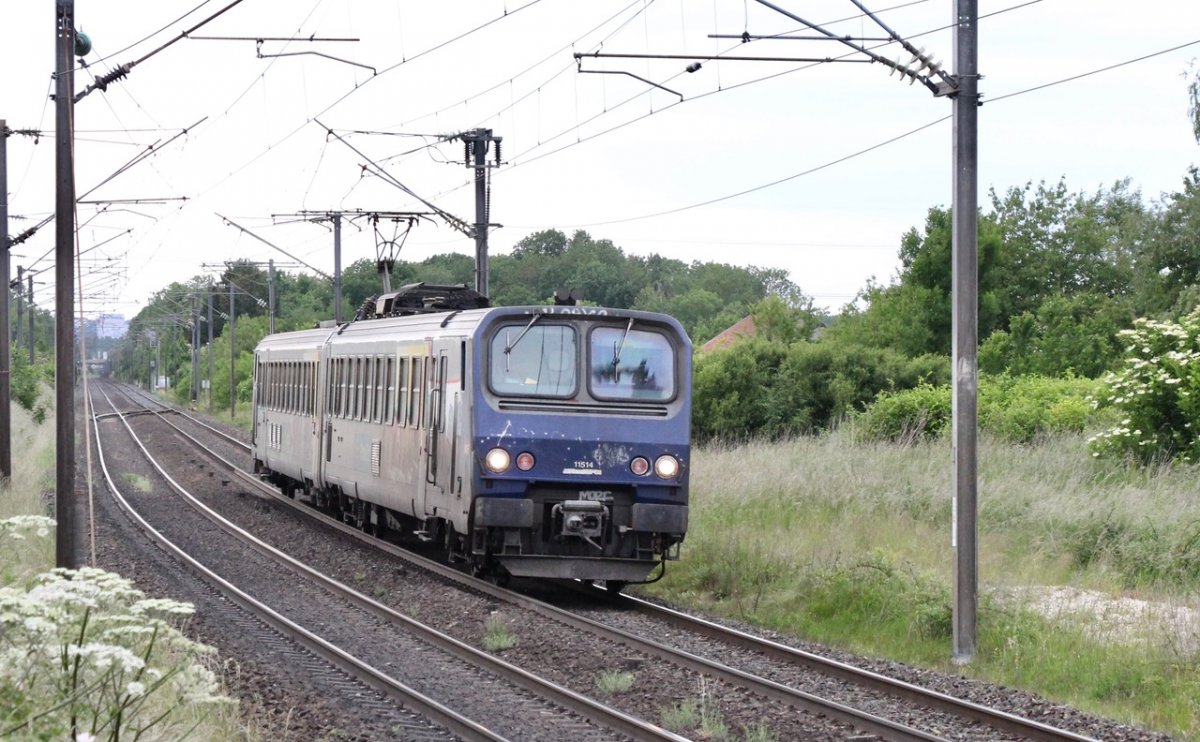
Restoration of the train service in September coincides with opening of GE’s train maintenance depot at Montigny-lès-Metz and arrival of new rolling stock. The line had been worked by Z 11500 EMUs based at Thionville, now 40 years old. Twelve of the original 22 sets remain in service, now confined to occasional runs on the Nancy – Épinal – Remiremont route. In extremely poor condition, they are unlikely to last into 2027. On 27 May 2025, Z 11514 is seen passing La Madeleine with TER 835826 18.20 Nancy – Remiremont. Photo: Christophe Costy.
Thionville – Longwy ‘improved’ service
Despite today’s poor patronage, the line is a key route in GE’s Lorraine-Luxembourg SERM project which proposes a half-hourly service and reopened stations at Fontoy and Florange (optimistically scheduled for 2028). This year sees work from March to September to modernise Mercy-le-Haut (199m) and Fontoy (325m) tunnels, to be followed by track upgrades starting in spring 2027.
BEMUs for Tours
By 2030, the région’s 16 two-car X 72500 DMUs and 20 X 73500 single cars will be over 30 years old. As well as replacing these, the BEMU order will include additional trains to cover the increased service frequency around Tours. Energising the non-electrified lines out of Tours is not in prospect, but discontinuous overhead will be introduced to recharge the BEMUs, mainly at the turnback points of Chinon, Loches, Vendôme and Château-du-Loir. This third stage of the project will not be implemented before 2040.
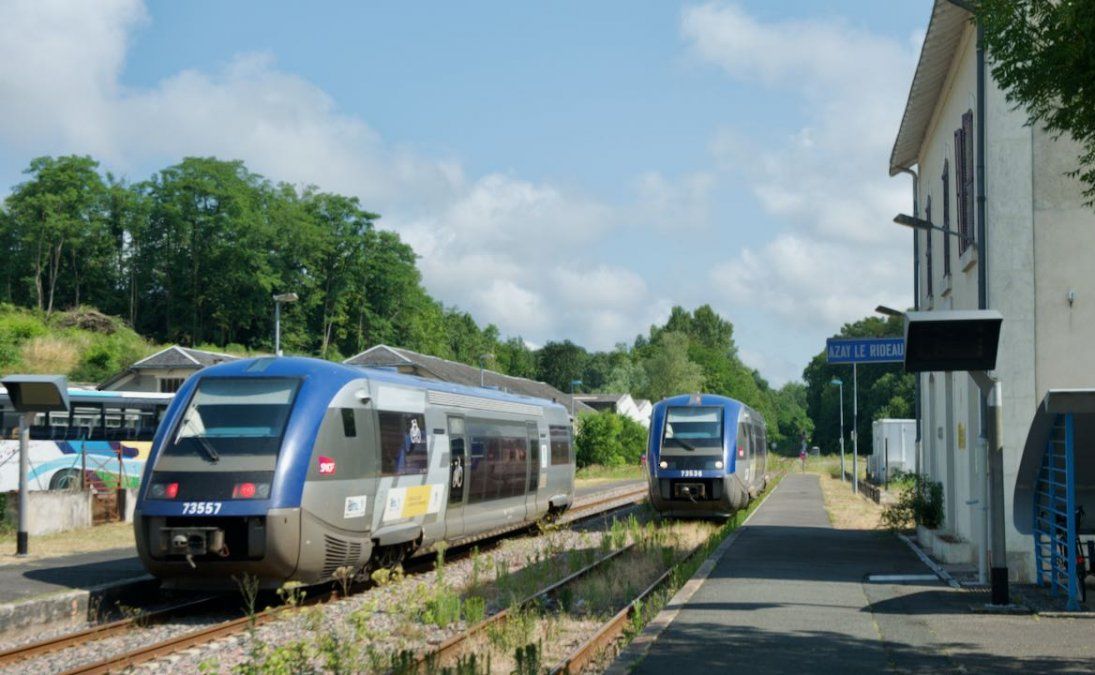
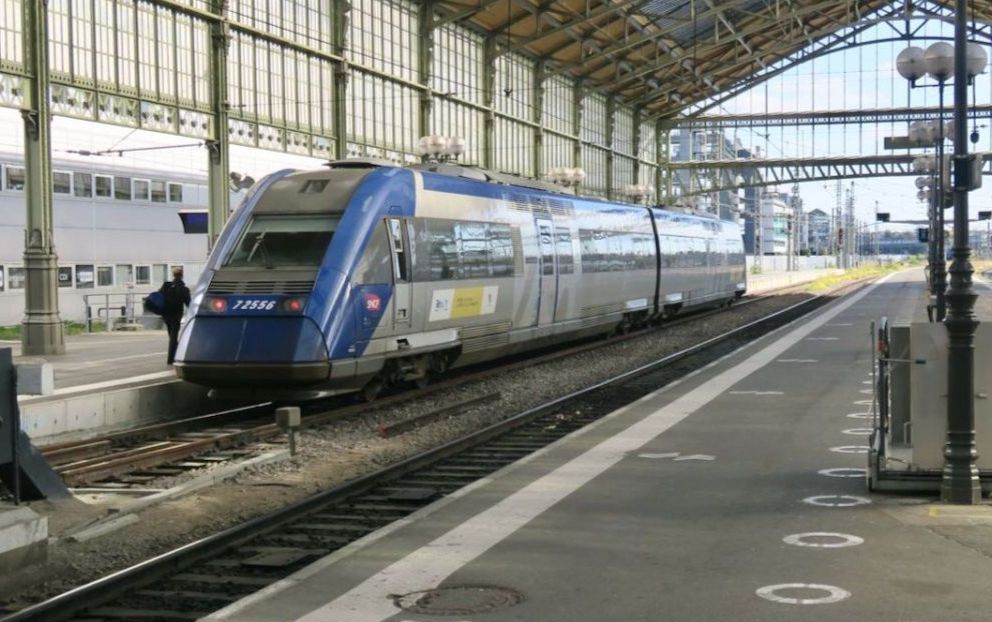
Left. At Azay-le-Rideau on 17 July 2024, X 73557 with the 11.09 Chinon – Tours crosses X 73536 on the 11.01 Tours – Chinon. Azay will be the terminus of half-hourly peak trains from Tours when the full SERM project is implemented. Right. On 16 October 2025, X 72556 waits to leave Tours on the rather humble duty of the shuttle to Saint-Pierre-des-Corps.
Following the public consultations, at the beginning of December Centre-Val de Loire région, Tours Métropole Val de Loire (TMVL) and Syndicat des mobilités de Touraine (SMT) submitted detailed SERM proposals for State approval. By 2040, the SERM network will serve 30 stations with at least one train every 30min in peak time, two tram routes, 29 express bus routes (of which eight ‘high-performance’, ie up to 60 buses per day), two carpooling lines, carsharing and transport on demand, all operating throughout an extended service day from 05.00 to 23.00, and with one ticket covering all modes.
Hydrogen trials. Centre-Val de Loire is not one of the four régions awaiting delivery of Alstom’s Régiolis H2 hydrogen-powered trains, though the iLint prototype was tested on the Tours – Loches branch in 2023. Now, following its visit to VUZ Velim last summer, B 84901/02 has been on trial between Orléans and Vierzon since December, with 160km/h running as part of its homologation process.
‘No kids’ backlash
Comments by the ministers for families and for equalities gave a further twist, with a suggestion that the restriction was probably illegal. One MP launched a motion to outlaw ‘No kids’ policies altogether. Media had fun with the fact that dogs did not appear to be banned from Optimum class. The government’s commissioner for children Sarah El-Haïry called the move “shocking”, saying that such policies “were not an option for a public service”. “SNCF has crossed a red line. This offer will be ruled illegal; it would be sad if SNCF became the first company to be convicted of child discrimination.”
SNCF quickly tried to limit the damage from what was “an unfortunate marketing error” according to TGV Inoui director Gaëlle Babault. PDG Jean Castex professed himself “astonished” by the scale of the reaction, pointing out that SNCF had carried 8.4 million children on TGV in 2025, a big increase on five years ago. SNCF “does not bar children from any trains” he said. “Optimum class is designed for business travellers seeking quiet workspaces, and does not undermine the presence of families elsewhere”.
Comment was not all anti-SNCF. Many travellers would be delighted to have child-free spaces, a demand which SNCF said it had strongly resisted. A snap survey showed 54% disapproved of the restriction, and 45% were in favour. Trenitalia said its rival service on the Paris – Lyon route does not restrict access to children under 12.

Christmas incident report
Investigations concluded that the driver had committed suicide whilst in a severely disturbed state of mind, an extremely rare event. Only one other case was found, dating back to the 1980s. The Atess ‘black box’ data recorder pointed up irregularities in preparation of the train before departure and erratic driving thereafter. Evidence found in the cab of the driver’s intention to spend New Year's Eve with loved ones, contrasting with the abrupt end to a chaotic start to the journey, suggested that he may have experienced a suicidal impulse.
Based at Saint-Étienne, the driver had unusually been permitted to continue working despite missing a two-yearly medical examination on 2 December 2024. He had lodged in Paris on the night on 23 December and had gone straight to his train the next day without encountering any other staff member. BEA-TT pointed out the value of communication with a manager before the start of a shift. At a minimum, it said ‘this would ensure the driver was not showing any detectable warning signs regarding his ability to perform his duties. It would also allow a staff member experiencing difficulties to report them more easily and enable the railway to take precautionary measures’. Irregularities and confusion were also found in the handling of the incident by personnel involved, including insufficient training in coping with out-of-course events. Recommendations were made in both cases.
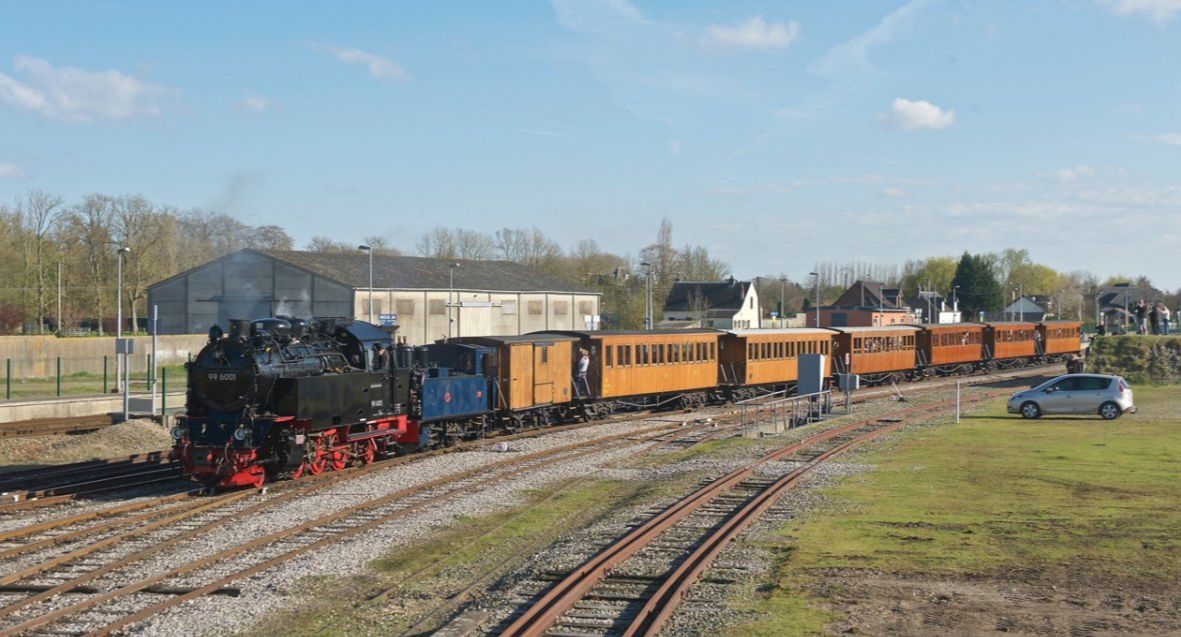
Preparing for the Fête 2016. After a day of clearance testing, visiting Harz No 99 6001 dwarfs Pinguely No 101 as they depart from Noyelles on 10 April 2016 with the 17.30 Le Crotoy – Saint-Valery.
Baie de la Somme - Fête de la Vapeur 2026
The Fête de la Vapeur 2026 will take place over the weekend 25/26 April. The event will begin at 14.00 on the Friday 24 with a display of the locomotives on the quay at Saint-Valery. On the following two days an hourly service will run between Cayeux, Saint-Valery, Noyelles and Le Crotoy between 10.00 and 20.00, plus a demonstration freight between Lanchères and Cayeux. The centre of the Fête will be at Noyelles where trains will re-engine and there will be various displays, catering, sales stands and other attractions.
The other main stations at Le Crotoy, Saint-Valery and Cayeux will be themed with various attractions and displays. At Cayeux, P’tit train de la Haute Somme will operate its 60cm 030 T No 1652 (Decauville).
Visiting metre gauge engines:
130 T G3/4 No14 ‘Madlaina’ (SLM 1479/1903) from Train à vapeur des Franches-Montagnes
230 T Réseau Breton No E 327 from Train des Pignes Historique
030 (Tubize 704/1888) HLV No 303 from Musée du Tram Vicinal de Thuin
030 (Tubize 704/1888) HLV No 303 from Musée du Tram Vicinal de Thuin
031 T (Corpet 534/1890) No 26 ‘Suzanne’ from Chemin de Fer Historique de la Voie Sacrée
Draisine à bras from the Brohltalbahn
Visiting standard gauge:
150 Y No 6690 and Nord 230 No D 9 from CFTVA with three coaches (2nd class Est suburban, 2nd class Est rapide and a Corail couchette)
Y DE No 20003 from Chemin de Fer de la Vallée de l’Eure
230 No D 9 and the Est coaches will be on static display at Noyelles along with CFBS former RB 230 No T E332. 150 Y No 6690 and the Draisine à bras du Brohltalbahn will be giving demonstration runs at Noyelles
The following are expected to be in operation from the CFBS fleet:
030 T No101 (Pinguely)
031 T No 3714 ‘Beton-Bazoches’
130 T No 2 Cail
130 T No15 (Haine-Saint-Pierre)
BB 60002 ‘Dracolas’
LXD2-326
Locotractor No 824 ‘Rolls’
No 352 • Tmh
No 986 ‘Le Cube’
On Sunday 26 April AAATV will run a special from Les Aubrais with A1A A1A No 68540 and a rake of 1950 DEV Acier Ordinaire and OCEM stock. After arrival at Noyelles it will run to Boulogne for stabling.
Vapeur de Trieux. This year the season is extended to run from 14 June to 15 September instead of only during school holidays, and timings have been adjusted to reduce the layover at Pontrieux from 5h 30 to 4h. Provision will also be made for one-way trips. Last year’s administrative and operating difficulties led to a loss of €100,000 which will be covered by the stakeholders and a modest rise in fares. The operation has now been granted a five-year authorisation. Problems with poor-quality coal clogging the loco’s firebox should be a thing of the past, with fuel from a new EU supplier on trial.
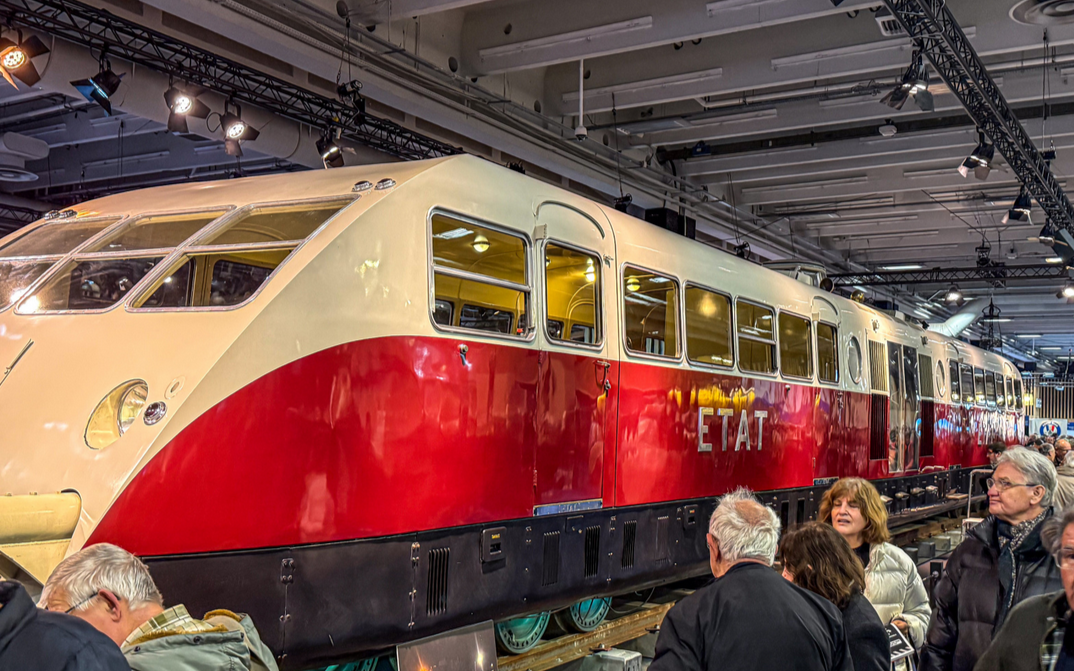
Preserved Bugatti autorail, 1933-built ZZy 24408 of the CF de l’État, loaned by Cité du Train Mulhouse, was a star of the Retromobile old-vehicle show held at Paris Expo Porte de Versailles at the end of January. The 50th anniversary show was a celebration of Ettore Bugatti’s career. Photo: Sortir à Paris.
Longueville. After receipt of a €300,000 lottery grant towards renovation of the roundhouse (see February News), Ajecta was disappointed that its bid for financial assistance from Île-de-France région has been refused. It continues to seek funding for the €1.3 million project, and is working with local tourism officials for restoration of running rights over the line to Provins and Villiers-Saint-Georges, withdrawn by SNCF two years ago due to the poor state of the track.
La Tremblade. From June to September, the Train des Mouettes will be celebrating the 150th anniversary of the Saujon – La Tremblade line, opened on 24 June 1876.

Following failure of the food court opened in 2019, the latest transformation of Nice’s Gare du Sud saw opening last month of the Halle de la Découverte devoted to cultural events, learning and a toy library. Still to come is a demonstration kitchen where chefs will show off the gastronomy of Nice. The former terminus of CF de Provence closed in 1991. Photo: Ville de Nice.

VéloRail Commequiers, which runs over 6km of the old line from Saint-Gilles-Croix-de-Vie to La Roche-sur-Yonne, is being renovated and extended ready for the 2026 season starting in June. VéloRail de Chauvigny, east of Poitiers, saw a record 22,000 visitors in 2025 and will reopen on 4 April with additional dates for the popular Apéros du viaduc food and wine evenings on the Vienne river crossing at Chauvigny. Photo: VéloRail de Chauvigny.
Urban News
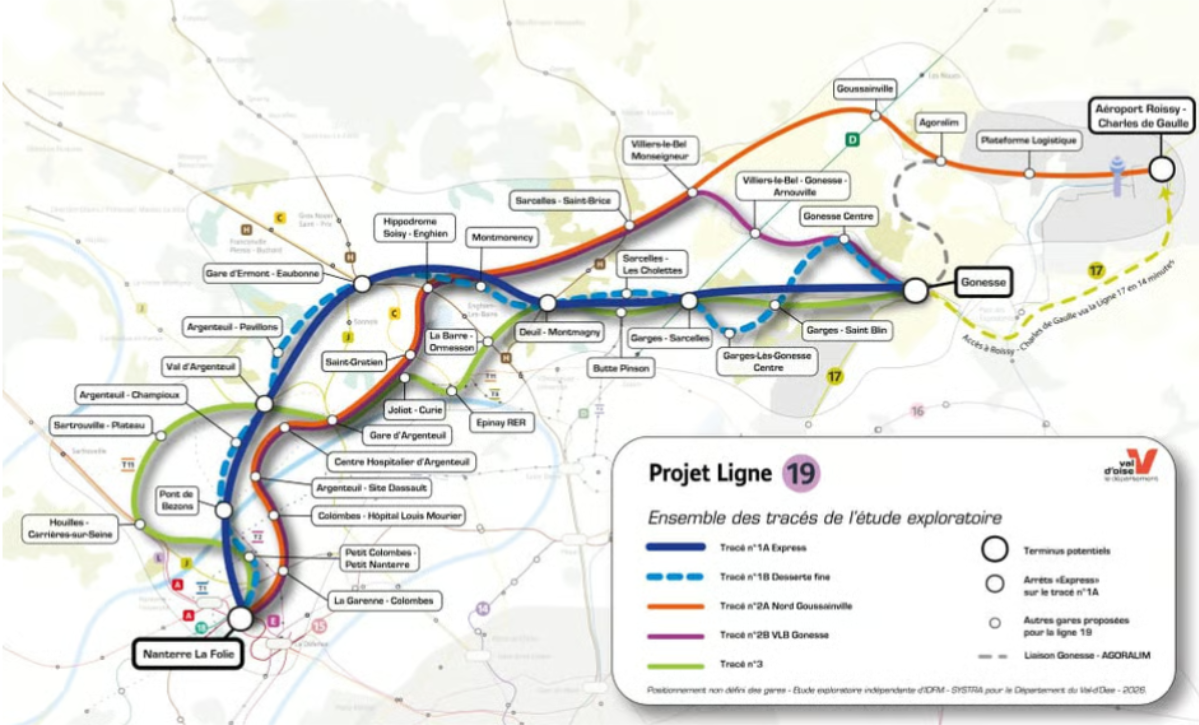
GPE Line 19. Studies by consultants Systra France and Mensia have produced several route options extending from 28 to 37km, each with up to 15 stations. Line 19 will link Nanterre-La Folie with Gonesse/CDG airport, offering a wide range of connections for residents of Val d'Oise and Yvelines départements. Cost is estimated at up to €6.7 billion; opening is unlikely before 2040. Map:Département du Val d’Oise
The Navigo annual travel pass will be available on smartphones from June, downloadable with one click using the ÎdFM app. At the end of the year, it will also be possible to buy and store travel tickets using Google Wallet and Apple.
Paris T1. Trial running started in January on part of the T1 extension to Val-de-Fontenay, using a tramcar moved to the Mozinor depot at Montreuil overnight on 11/12 December. The first section from Noisy-le-Sec to Rue de Rosny in Montreuil will open in 2028; 7.7km, 10 stops. Photo: Ville de Montreuil.
ÎdFM’s reorganisation of bus access to Charles de Gaulle airport saw the RoissyBus shuttle from Opéra to the airport cease running on 1 March. Passengers are being encouraged to use RER Line B (fare €14), with frequent trains from 04.50 until midnight, prior to opening of the premium CDG Express from Gare de l’Est next March (fare €24), and then GPE Line 17 by 2030. A new express bus 9517 runs to the airport from Saint-Denis Pleyel.

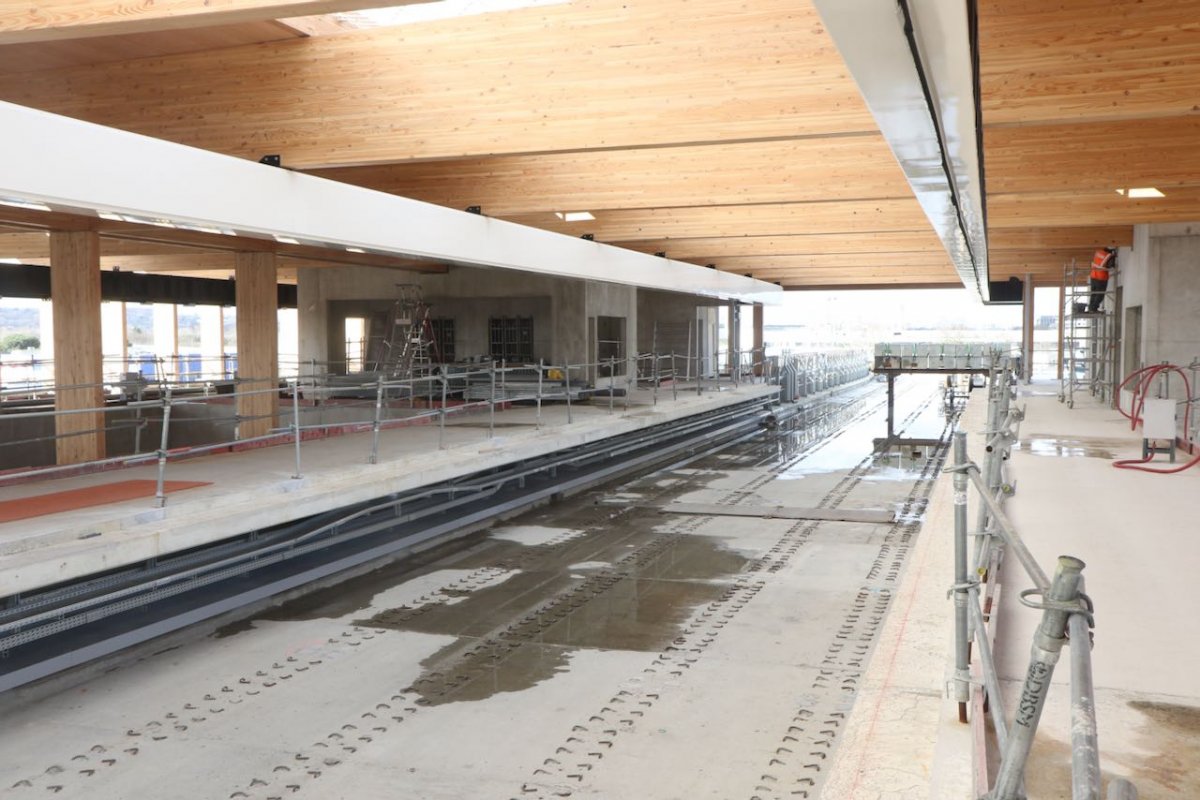
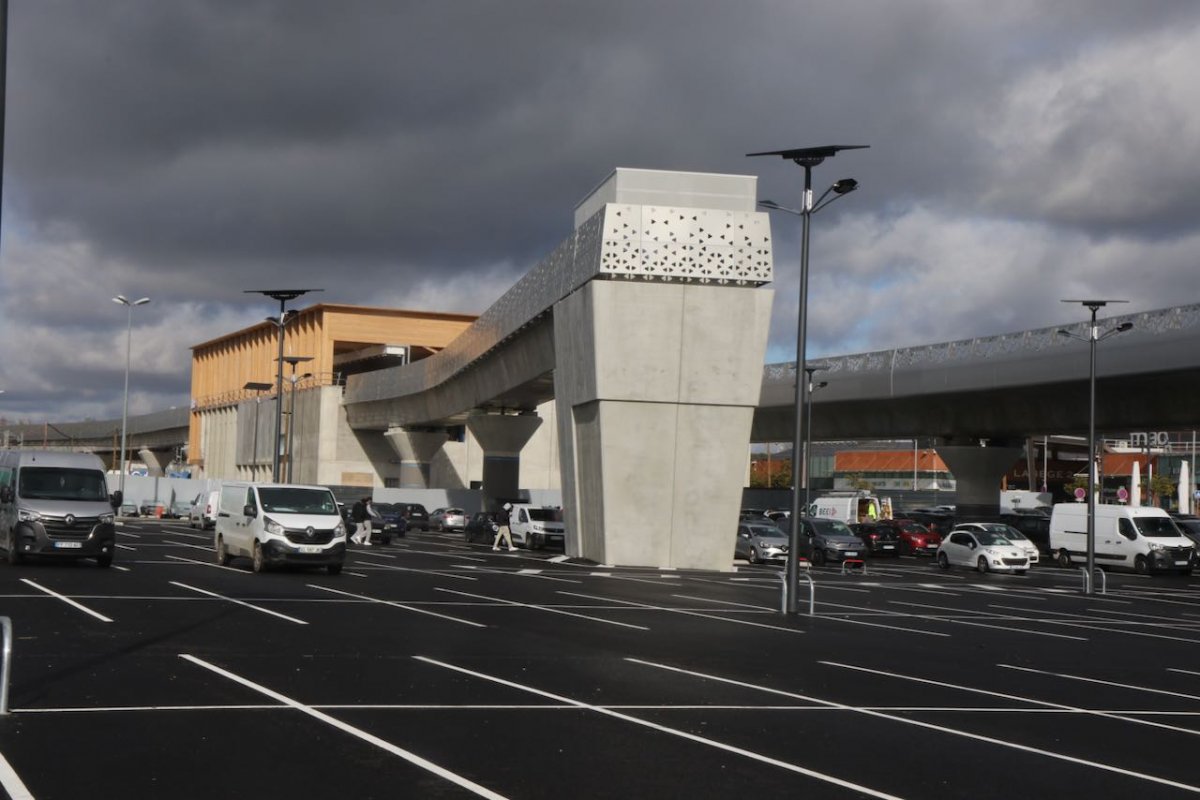
Toulouse. Work is nearing completion on the Line C interchange with the Line B extension from Ramonville at Labège Madron. Below left. The station interior showing the trackbed for the future line C. This will continue to Labège station, where there will be a future connection with the TER regional trains on the Toulouse – Carcassonne line. Below right. The exterior of Labège Madron. Line B is on the left and ends with a section of viaduct that can be used as a siding. The double track viaduct for Line C is on the right.
Photos: Georges Turpin.
The suggestion in the loi-cadre put before parliament on 11 February (see February News) that urban transport fares should rise to reduce the current average subsidy of 83% was rebutted by the economy minister Roland Lescure. “Users will not be asked to pay more,” he said. "Public transport is subsidised, and that's fine”. The law proposed increases linked to the rate of inflation that would gradually raise passengers’ contribution to 30%, still only one-third of the 1970s figure.
Lille. Alstom Boa211 trains went into service on Line 1 on 14 February, 10 years later than the original start date for these trains ordered in 2012. After a long and difficult commissioning, staff went on strike in protest against ‘working conditions, stress, and sometimes strained relationship with Alstom technicians'; the tramway was also at a standstill. Their introduction was not entirely smooth, with several incidents being recorded in the first few days. By the end of the year, 27 sets should be in service, with the remaining 15 in 2027.
Montpellier. Within two months of opening on 5 December, Line 5 was carrying up to 40,000 passengers daily, the park-and-rides particularly well used. Frequency is to be raised from five to six trams/h after the winter holidays on 9 March.
Additions to FRS Photographic Archive during February 2026
To Locations section
- LVDR 1047/May 1966 on Petite Ceinture
- LVDR 1069/Nov 1966 on Grande Ceinture
- LVDR 1333/Mar 1972 on CIWL Histoire des services Pullman
- LVDR 1534/March 1976 on SNCF 140C
- LVDR 1599/June 1977 on CIWL Simplon-Orient Express
- LVDR 1707/Sept 1979 on CIWL Sud-Express
- LVDR 1727/January 1980 on SNCF type 2D2 on Sud-Ouest
- LVDR 1743/May 1980 on Le Mistral @ 30 years
- LVDR 1777/Jan 1981 on CIWL Nord-Express
© Peter Lovell & Chris Bushell. The French Railways Society 2026. With thanks to Georges Turpin, Christophe Masse, Didier Delattre , Pierre Julien, Christophe Costy and Philippe Leynaud.